
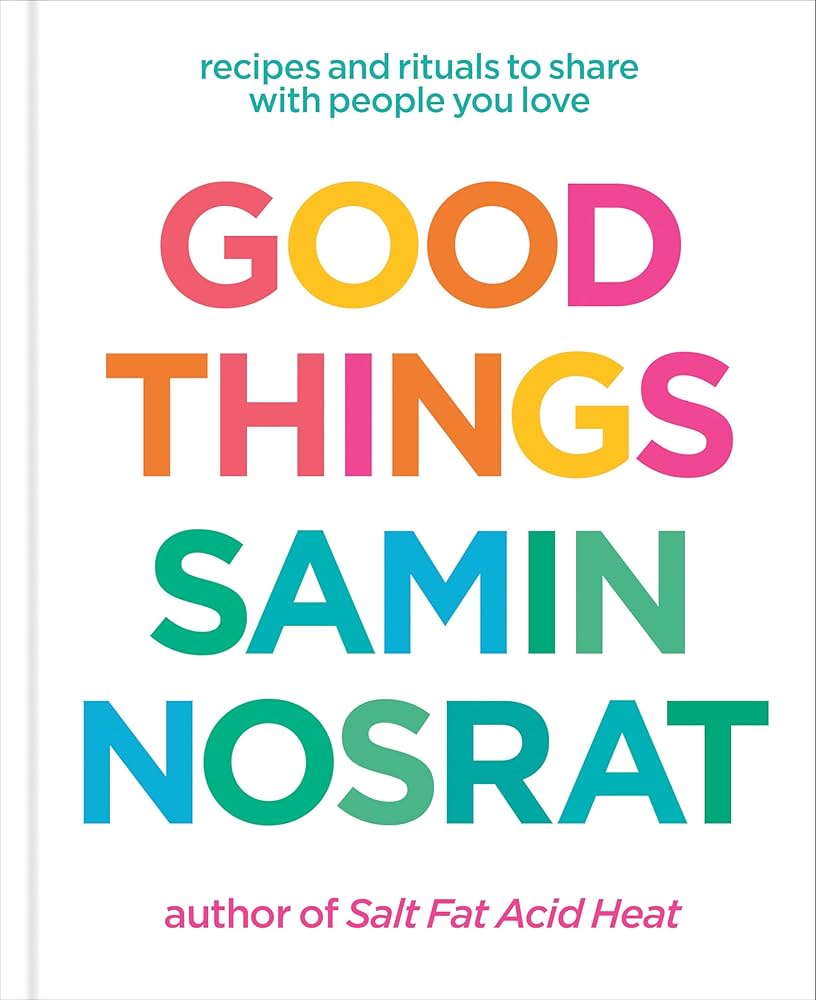
 Join beloved chef, author and cultural phenomenon Samin Nosrat as she shares intimate revelations about creativity, connection, and what makes a life worth living. Known for transforming how millions approach cooking through Salt, Fat, Acid, Heat, Samin opens up about her journey from perfectionism to presence, and how witnessing her father’s passing reshaped her relationship with time, achievement and meaning.
You’ll discover why weekly dinners became her “secular church,” how depression led to deeper wisdom about true nourishment, and what cooking teaches us about giving and receiving love. Through stories both tender and profound, Samin illuminates themes from her new book “Good Things: Recipes and Rituals to Share with People You Love” while offering a master class in moving beyond performative gatherings to create genuine connection.
This conversation explores what happens when we let go of striving and create space for what matters most. Whether you’re a home cook yearning for more joy in the kitchen or simply seeking inspiration to live with greater intention, Samin’s hard-won insights will help you discover how small rituals can become transformative acts of love.
Perfect for anyone interested in:
• Building meaningful relationships through food and gathering
• Moving from perfectionism to presence
• Creating simple but profound weekly rituals
• Finding purpose beyond achievement
• Living with greater intention and joy
You can find Samin at: Website | Instagram | Home Cooking podcast | a grain of salt substack | Episode Transcript
If you LOVED this episode:
- You’ll also love the conversations we had with Samin about her journey from anxiety and depression to finding joy through food, writing, and community at Chez Panisse. Her earlier visit also offers a wonderful complement to today’s conversation.
Check out our offerings & partners:
- Join My New Writing Project: Awake at the Wheel
- Visit Our Sponsor Page For Great Resources & Discount Codes
photo credit: Amanda Marsalis
_____________________________________________________________________________________________________
Episode Transcript:
Jonathan Fields: [00:00:00] Hey, so my guest today is award winning chef, writer, teacher and gatherer of people, Samin Nosrat. She wrote the iconic book salt, fat, Acid, Heat and starred in the beloved Netflix series of the same name. That really changed the way millions of people understand food. And now she’s back with a new blockbuster book, Good Things, which celebrates the power of simple meals and shared tables and the essential role of community in a life well lived. But our conversation, it’s about something much bigger life. Some highlights include a moment of unexpected rebellion that just cracked open a lifetime of swallowed emotion and sparked a new sense of self, or a surprising truth about achievement that reveals why doing the right things can still leave you feeling just deeply empty and alone. Or a subtle but powerful shift in how you think about time that can reshape the way you live and love and work, and gather in a simple weekly ritual that becomes a lifeline back to connection, belonging, and joy. These are just a few of the threads we explore, really, in a conversation that feels tender and honest and human. It’s about the quiet moments that shape us, the loud ones that shatter us, and the small, consistent acts that stitch us back together. It’s about letting yourself be seen and letting others in, and it’s about reclaiming joy and meaning and presence in the most everyday of ways. This conversation moves through life’s big transitions identity, fame, depression, friendship, weekly dinners, and the meaning of a good life and the healing power of sharing time and food and presence with people you cannot get enough of. It’s wide open and intimate in the most beautiful way. So excited to share it with you. I’m Jonathan Fields and this is Good Life Project.
Jonathan Fields: [00:01:45] Yeah. You know, excited to dive in.
Samin Nosrat: [00:01:47] I really love talking to you last time.
Jonathan Fields: [00:01:49] Yeah. I’ve learned since our last convo also that you and I have some kind of weird overlaps. Oh, cool. So out of the gate, I open up your gorgeous new book. And of course, it’s gorgeous because it’s you. And I’m looking at the photo opposite the intro page, and it’s this old blue notebook that’s obviously really well used. And sitting on top of it is a Blackwing Palomino pencil.
Samin Nosrat: [00:02:08] Oh, I love them.
Jonathan Fields: [00:02:09] And I’m like, okay, like that one choice says so much about who you are as a human being. And by the way, I’m holding up right now. This is this is this is one of mine.
Samin Nosrat: [00:02:20] That the volumes.
Jonathan Fields: [00:02:20] Yeah. This is one of the, uh, the the the Shepard Fairey Blackwing. Um, I love those pencils.
Samin Nosrat: [00:02:26] They’re so good.
Jonathan Fields: [00:02:27] There’s something magical about them. I don’t know why. I mean.
Samin Nosrat: [00:02:30] They’re just a delight in that. Like, they look different and they feel so good. But also, the lead is just a dream. Yeah, I kind of. At some point, I was like, I know they’re expensive, but I just can’t have any other pencils.
Jonathan Fields: [00:02:43] I’m the exact same way. All right. We’ve established that we’re both nerds around writing and writing implements and things like that. Um, I was listening a little bit earlier this year, actually, to a conversation that you were having with your dear friend Rishi on the Song Exploder podcast, and you were talking about a moment where you were on a, um, a visit to Vassar, potentially looking at it as a place to go. A friend invited you to this Ani DiFranco concert, and you heard for the first time this song, Untouchable Face, that kind of changed your life and, like, let you feel deeply and expressly in a way that you hadn’t in a really long time, actually had Ani on the podcast. Oh, amazing. Over the summer.
Samin Nosrat: [00:03:24] Amazing.
Jonathan Fields: [00:03:24] And we were talking about how music can change people. One of her older songs I was listening to just before I sat down with her and I was sharing how I was literally hiking in the mountains listening to this song, and I was I was just weeping as I was walking. And I’m like, this song was not written for me or to me, but it was there was something so powerful about it. Your story of how you were moved by this one song, it just really stuck with me. Um, can you share a little bit about that moment and what led up to it.
Samin Nosrat: [00:03:57] Yeah. So I’m the child of Iranian immigrants and I you know, I think one sort of fundamental thing that I learned as a young kid was do your homework, study, get into a good college like that is the most important thing. And so I really took that to heart. And I did that. And I ended up at a really sort of academically rigorous school and high school, which was just sort of like made to send kids to, you know, high end colleges and universities. And at some point, I decided I wanted to go to Vassar. I had a friend who had gone there. I heard about it, sort of became my dream school. And so I applied and I got in, you know, and this was this thing, like I’d been told, like study, go to school, like, that’s the thing. So I sort of, like, held up my end of the bargain. And then as this sort of like date was approaching, of the decision of someplace to go, I think it was dawning on my family that I really wanted to leave. And my grandfather, who like my grandma. Nobody. In so many ways, I was this sort of like typical older immigrant child who had to, like, figure out a lot of things for myself. And so a lot everything about applying for college and what college to go to.
Samin Nosrat: [00:05:13] I was just, you know, it was not family guidance that was getting me there. It was curiosity at school and asking teachers and friends. And so I think finally they were like, oh, she’s gonna leave. And that’s not okay. Like with our family culture and our values. And so my grandfather told my dad, like, you have to tell her she can’t go. And so we went on this, there was sort of like a I was like, well, we got to go see the school. My dad took me to visit Vassar and he dropped me off, and I stayed with my friend, and she was like, oh, we’re going to go to this concert tonight. And I was like, okay, whatever. Like. And so it was this person, Ani DiFranco was singing who I didn’t, I wasn’t familiar with, I didn’t know, and here I just felt like, ooh, I’m on a college campus. And, um, so we go to this concert. I’m not familiar with this music at all. And then at some point, probably either, I think toward the end, I’m guessing toward the end, she starts playing the song Untouchable Face. And I’m sorry, I don’t know the words, so I’m just sort of like trying to pay attention. And everyone starts singing along, and there’s a point where she says, fuck you and you’re untouchable face. And that just felt so transgressive because here I was, just this like, goody two shoes.
Samin Nosrat: [00:06:31] Like following the rules, pleasing all adults. You know? I was like, what? We’re in a chapel. And she’s saying, fuck you, you know, like. But it was just like the room filled with this energy. And so it sort of became like the anthem of this trip, which sort of soured the trip sort of soured. And like, while I had a really nice time with my friend and I sort of was spent the whole weekend envisioning myself there, you know, unbeknownst to me, my dad was sort of collecting things to use, like against the school as an argument, and so that when we returned, he was like, no, no, no, this place is far too liberal, like, you need to stay home and go to UCSD. And I kind of knew inside that if I did that, there was just something in me that I was like, I’ll die. I’ll die. Like, maybe not really, but like, something inside of me will die. And I knew I had to get out. And so there was just this very long, ongoing family, um, schism, I guess that happened over where I was going to go to school, which I know on the one hand sounds so privileged and like crazy to have this sort of meltdown about like, which top tier school you’re going to go to.
Samin Nosrat: [00:07:39] But it also was the only thing that I had been told to do and the like my whole existence had been about fulfilling this thing I’d been told to do, and I was doing it. And then at the last second, like family members who, like, had really not been very interested or like, curious about anything about my academic life. Like all of a sudden we’re then going to take that away from me. And it just felt like so threatening and so scary and, um, ultimately led to, like, an estrangement with my dad for the rest of my life. And so there was just this way that the song. I never said anything bad. I only did good things, you know, like, and there was this, like, bad word in a song. And I was sort of discovering my own capacity for anger and resentment at my parents, who to me, I had only ever listened to and obeyed and tried to please. And so there was a way where this song became representative of that moment, and also sort of that like ongoing, sort of like period of young adulthood in my life. It was a real shift for me, but I think a big part of it was like a discovery of this part of myself that I didn’t know I had.
Jonathan Fields: [00:08:53] Yeah, it’s like, oh, there’s this feeling that sometimes probably rises to the level of rage inside. That’s like, I’ve done everything right. I’ve checked all the boxes. Like, you know, like I’ve everything that’s been asked of me, I’ve done. And I got the thing at the end of it that I was supposed to that was supposed to be the reward. And now it’s not being offered to me. And it was like this moment in you where you’re just like, this is not okay.
Samin Nosrat: [00:09:17] Yeah. It was such a it felt such a betrayal, you know, and the song was just such a beautiful like.
Jonathan Fields: [00:09:22] Right. It’s like I can I can express this, like I can feel it, and then I can actually let it out, like, that’s real. It’s raw. Um, I think so many of us, I think, have like, those moments. Um, here’s a bigger curiosity around this also. So fast forward, right? Like years go by, like at Berkeley, you’re like going to the world of food. This stunning phenomenon, salt, fat, acid heat comes out seven, eight years ago. You end up creating something that I’m going to make the analogy, you might be uncomfortable with it that, like Arnie went out into the world and actually changed, touched millions of people’s lives to or at least brought, you know, moments of joy and deep connection. And I would imagine for a lot of people, reconnection to people that maybe they were estranged from back into their lives. Um, as that was happening. Um, and I asked Arnie this question, I was like, how did it feel to be somebody who creates work that does that? And she was just kind of like it. Like in a way, it’s like it wasn’t me. Um, I’m curious what your experience was of being behind a phenomenon that landed with people that moved people like that?
Samin Nosrat: [00:10:29] Yeah, I agree with that. I think I have sort of two parts of it. One is I made a book, I made this thing, and I put it out in the world, and I always was pretty clear. Once I put it out in the world, it wasn’t mine anymore. And in some ways I now feel very distant from it. You know, like I just look at the book and I’m like, oh, interesting. Like, it’s nice that it’s a physical thing that I can look at that I made, that I can have sort of a material relationship to, you know, because I can really let go of it in that way. But also there’s then the part where there’s almost like some sort of like synecdoche or something that happens in people’s minds where they conflate me with the thing. And I’m sure that that in large part happened because then there was a television show around the world that they could see me and get to know me or or feel like they got to know me. And so then I become this, like, you know, symbol for salt, fat, acid, heat, which is like, I’m very aware that my name people know salt, fat, acid, heat way more than they know my name.
Samin Nosrat: [00:11:35] And I like that. I don’t want them. I don’t need everyone to know my name. So I am like a piece of this bigger thing. But there’s a lot that gets projected on to me by people, and that it has been hard for me and is complicated. And yeah, I’ve really struggled with, partly because, like, I want to offer people what it is that they want from me, you know, I want to give them joy. I want to give them a moment of connection when they, like, stop me on the street or see me, or are having a great, like excitement when they, like, run into me in a store or something. But I also am like a person having my own experience of my in my body and in my life and in my head. And it’s not always aligned with like being able to do that for people because I it also costs a lot for me. And so that has been a big struggle is sort of the yeah, becoming the symbol of the thing.
Jonathan Fields: [00:12:34] Yeah. And I think for anybody who puts work into the world, um, that in some way touches other people and maybe, maybe some people are totally fine with it. Maybe some people would just, like, bring it on like I am the thing. And like, the more direct the channel, the better. I’m more like you. Like I’ve never been like. I’m like, I love to create things that go into the world, and the thing becomes the source of whatever it is. Like, I don’t even care if anyone knows my name. I would almost rather like they don’t. So I can just kind of live in a cave. Um. I’m just it’s never been about that. And you had this this moment where you. It wasn’t just the book. That was the thing you as a human being were. The thing. Your life, your lens, the way you showed up was the thing. Um, when we last talked, you know, this was.
Samin Nosrat: [00:13:17] Had the show come out or had the book come out when I talked, I.
Jonathan Fields: [00:13:19] Think the show had come out. So this was like late 2018, if I remember correctly. Right. So the show is probably pretty recently on air. So that brought a level of just exposure to you as a person on a whole different way. And back then you actually mentioned to me, um, heading out to a cabin in the desert away from everyone just to kind of get your bearings back and figure out what you wanted with this torrent of attention coming at you. Um. You. I wrote down, actually what I was just listening to, I wrote down, you said. I realized I’m not in a place to say yes or no to anything, so I’m just putting a hold on any decision making until I have quiet time to figure out what makes any sense to do. I know if I don’t decide to do something because I care about it in my heart, I will be miserable. Um, um.
Samin Nosrat: [00:14:06] I’m in the opposite place now where I’m like, I just want to say no to everything.
Jonathan Fields: [00:14:09] Yeah. I mean, and I’ve been I’ve been curious about that. Like, did you did you take that space and we’ll talk about some of the stuff that’s unfolded in the intervening years also. But like, I felt like when we talked last time you were in this window where you’re like, my head is spinning. They’re they’re astonishing things happening, you know, coming. You use the word coming at me. Yes.
Samin Nosrat: [00:14:28] It was all coming at me.
Jonathan Fields: [00:14:30] Right. You know, and on the one hand, it’s like, what an incredible blessing. How can I not just, like, acknowledge that? And on the other hand, you’re like, how do I live through this? Um, what was sort of like the immediate future after that, like for you.
Samin Nosrat: [00:14:42] Um, I did go to the cabin in the desert, and then I invited press there. Like there was a way where, I mean, not for not the whole time, but there was a, like at one, one thing I let come there, you know, and I’m like, why did I do that? There was just I’m not so good with the boundaries. Um, I’m getting better. But like, I also yeah, it’s interesting to hear that I said it that way, that I, I needed the quiet because I didn’t want to miss something good, whereas now I’m like, I need the quiet because I need to make space for whatever it is that I want to do. Right? Like, uh.
Jonathan Fields: [00:15:19] Because that’s a big difference.
Samin Nosrat: [00:15:20] Yeah. Like, um, I need and I also just need, I need rest. Yeah. Um, um, I came home, you know, I basically, since August, have been to nearly 30 cities, and I came home like a little over a week ago, and, and I also was sick by the time, you know, you get worn down. And so I was just so exhausted and so sick. Just like physically. My ankle was sprained, like everything falling apart. And I was like, I don’t want to do anything. There’s all these things, like, there are a few things I sort of have to do next year. And I’m like, cancel that. I’m like, just end the Substack, quit everything. Like, don’t, I don’t want to do anything. And as I have, like, you know, my sinus infection is sort of like gone down. I’m a little better now. I’m like, okay, maybe I don’t like that’s not the best place to make decisions from, but I’m just I have the opposite feeling now of if I say yes to things that are not like truly, truly coming from deep inside of me, I will regret it. And in a way, that was part of why making the second book was so complicated and hard for me was that on the one hand, like I did want to make a second book and I had a good idea. And on the other hand, I very much like felt the pressure of the strike while the iron is hot and sell this idea right now.
Samin Nosrat: [00:16:39] And so I, I did do that. I actually I worked on that book proposal in the desert and, um, I thought I was taking time because it was almost two years since salt, fat, acid heat had come out. But it wasn’t enough quiet time to get really, really clear inside of myself. It’s very scary. I live in such a. We all live in such a, like, production focused world and like, you know, the forces of capitalism just are so intense. Even if you’re try to be aware of them. And on some of us more than others, there’s just that like pressure often from inside to produce and make. And I really have that. And so it’s been hard for me to be like, I’m just gonna have some fallow time, which the world and my life sort of forced me into, regardless of whether or not I was going to do it. I mean, not only the pandemic, but then I sort of had an extended period of like grieving. And then my I had another sort of extended period of my dad dying and then like the sort of aftermath of that. So there was a lot of ways in which, like the circumstances of my life forced me to stop working. I just couldn’t. I like just physically and emotionally, like, wasn’t able to. So, um, but how nice would it be to make that a conscious choice and decide to take some downtime rather than to, like, be forced into it?
Jonathan Fields: [00:18:01] Yeah, and I think so many of us, like, we don’t actually do that until we’re brought to our knees by something outside of us, or something that’s a blend of inside and outside. And we’re like, oh, like I’m now I guess I have to listen because I actually can’t do anything but that. I often wonder why it takes that, you know, we both sat down with so many people who were studied and, you know, like deeply philosophical and theological, and they know all the things. It’s one thing to know. It’s another thing to to practice and to live your life that way. You know, it’s a different thing, especially when you have, you know, and as you describe, like your whole upbringing, you sort of like you’re brought up with a certain ethos, you know, and then you take that and you bundle it with, hey, something astonishing has just happened to you. That happens to almost nobody. The window is probably only going to be open for a short amount of time. Take advantage of everything you can while it’s open. And meanwhile there’s a voice inside of you saying, but that might kill me. Yeah. Yeah. You know, and like, you’ve got to battle that. And it’s a fraught place to be.
Samin Nosrat: [00:19:03] Yeah. And there’s a whole other layer of I’m sort of internally going through this thing, while externally the world is sort of observing me be a capital s success, and I’m getting all of the sort of attention and praise and trappings of that, that in many ways I’d always wanted that wouldn’t anyone want? And certainly that most of my friends who are writers and other types of artists and creative people would give anything to have. So it felt really complicated to have a tortured relationship to it, and it still does. Like, I don’t want to come off like I’m complaining. I’m so grateful for it. And the other thing I didn’t get to say when you asked about, like, how do I feel about having made this thing and the people’s response to it? Like some of the best moments, like it’s I don’t have the ability to sit back and look at like what I’ve done for the world and like, think about it in a, in a in a sort of zoom out 30,000. I can’t do that. I that would not be good for my mind or my ego or anything. But there are these little glimpses and these little moments that I get to have when people come up to me and I’m in a receptive place, and especially when it’s like any sort of type of like marginalized person who often says something about, like what? Not only the work has meant to them, but seeing me has meant to them, and that often is like the most sort of fulfilling, part like thing response type of response that I can have and gives me the best feeling about like, wow, this feels really good because I know I didn’t get to see somebody like me for for my whole life. And so that’s something I’m really proud of, is that I get to be visible for people who don’t feel seen.
Jonathan Fields: [00:20:57] Yeah. I mean, and part of me wonders at the same time. Like, I hear that and like, that must feel really incredible inside. I wonder if there’s another voice that sometimes accompanies that that says, especially for like as you describe, like if you start to become seen as the model representative for marginalized person. Um, is there a sense of responsibility that then you step into, well, I’ve got to behave in a certain way. I’ve got to show up in a certain way, because now people are looking to me to see, like how to stand in this moment, what’s possible. And what if I fall?
Samin Nosrat: [00:21:30] Yeah, I definitely feel that. I feel that just in my tiny ways. Like I basically put on a cloak when I leave my home, like a some sort of protective cloak of like, not only like my energy force field, but also just, I kind of know there’s like a subconscious sort of like switch that clicks of like, I, I don’t know, you can’t throw a tantrum in public. You can’t be grumpy at the coffee store like, you can’t I can’t cut people off in traffic. Not that I’m always trying to or whatever, but like you sort of, I just am very aware that it means something, you know, like, my girlfriend and I will be driving and she’s always like, you drive like a grandma. And I was like. And she’s like, make a U-turn, take that parking spot. And I was like, oh, no, no, no. I was like, I can’t do that. Like I can’t make an illegal U-turn in the middle of the street, like someone will see me. I’m like, no, no, no. There’s just a sense that I can’t do that. I can’t be that way, which I’ve like. It’s not an unfamiliar sense to me. It’s just amplified.
Jonathan Fields: [00:22:29] Yeah. And we’ll be right back after a word from our sponsors. So the pandemic hits, as you shared. You know, your dad also drops into illness and eventually passes. And kind of like through weaving through like, this same season ish, you also start to realize that there’s you’re looking back at your life, especially your very early life, and realizing there’s there’s a lot of anger in the house. And there is a lot of probably grief that you didn’t realize for an older sister that had died very young when you were didn’t really have any memories as an adult. But you’re starting to realize maybe actually there was something there for me that I’m just not processing. So there’s like this soup of disruption, grief and loss that’s just like perpetually being stirred with you. Um, and and then, you know, the pandemic kind of, like, makes it hard to process and be with people during this whole thing. For you, it sounds like Making like working with, with food and with with raw materials. Um has always been such a place of sanctuary and salvation, especially being able to actually do that with others that you love. And but this was a time where it sounds like it was harder to do that.
Samin Nosrat: [00:23:44] I mean, due to the depression, I lost my appetite.
Jonathan Fields: [00:23:48] Um.
Samin Nosrat: [00:23:49] I lost my own interest in cooking, and the cooking has largely been a way for me to connect with friends. It’s often, and through most of my life, been like a really social work, you know, like, like just you go to work and you cook with other cooks and you talk and you see what they’re doing. And there’s like sort of inspiration, but also just like fun and collegiality. So, um, that, you know, I didn’t have and I was just so lonely. I was so lonely in all of the ways. And, you know, I. Love that your show is called Good Life Project. because that was sort of became in a way like that could have been the title for what I was doing was I was trying to orient myself. I kind of got this clarity. I was like, I spent my whole life trying to achieve because on some level, I believed that achieving and producing would lead to happiness, would it would make my parents happy. It would make me happy. It would fill this like deep hole in my heart and like, I would no longer feel this like deep sense of loneliness and sadness, that is. I’ve always thought of sort of as my oldest friend, and I’m therapize enough to know, like, that’s not it was not my it was not a conscious thing that was driving me.
Samin Nosrat: [00:25:19] But once I did get all the achievement and I was lonely or and sadder than ever, it sort of forced me to acknowledge that I had had that flawed thinking all along. And before the pandemic, probably around the time I was coming to New York, probably around the time I saw you, one of my friends, Greta, had moved back to New York from California, and she had just started having these weekly dinners and she, um, like, fell in love and found a new partner who was really thoughtful person, one of, like, smartest, most thoughtful people I know. And he, in so many ways also has, like, all these trappings of success and also is just one of the most sort of like spiritual, careful people I know. And so there was a way, whenever I meet someone who just like is, has, has somehow done things differently and is like doing something so interesting. And I’m always so curious, like how they became them. I’m sure this is like the entire premise of your whole show, right? Basically, yeah.
Jonathan Fields: [00:26:22] For 14 years You’re like. You’re like.
Samin Nosrat: [00:26:25] What happened in your life? Who do you, you know, like, was it your parents? Is there something in you like, how did this happen? And so I like I just started having so many conversations with these two friends and a big question I found themselves them asking themselves was like, what is a good life? Like, what’s the life that we want to build? And some of that was sort of being coming manifest through these weekly dinners, but also, I think just in other ways of the choices that they were making. And it’s interesting, you know. To see people who from the outside appear like they have it all, to still be like, really grappling with this. And, and to me, that was like a really just helpful thing. And so I got into these sort of conversations and that became this question that I just started asking myself, like, what is a good life? Because I had not had financial stability, I had not had support systems, I had not had, I don’t know, recognition for my work. And then I kind of got recognition and I got financial stability. And I always when I didn’t have it, I thought if I had that, I would feel okay. And then I had that and it didn’t solve the problem. And so I was like, okay, well, clearly there’s some flaw in my thinking, so I need to figure out what I can orient myself toward. How do I answer this question? And so that really became this thing. I just was sort of like, ask myself in all these different ways and in some ways has become the barometer by which I can make other decisions of, like, do I want to do this thing? Well, that take me closer or further away from a good life, you know? But like, yeah, just trying to sit with like, what is a good life really became the sort of driver of my life in that time.
Jonathan Fields: [00:28:14] Yeah. Um, it’s one of those questions that I think a lot of us ask in passing, you know, obviously for, for me, it’s become a bit of an obsession for a long time. And I’m always like, like you. I’m always kind of like, if I see somebody and like, there’s just a twinkle and you’re like, they’ve figured something out. I don’t care if you’re famous. I don’t care if, like, nobody knows you at all. It’s just like, oftentimes it’s it’s the quietest, most unknown people that I bump into and you’re like, oh, there’s something that they know that I want to know that they’ve figured out. And it’s amazing to sort of like, just be in the question. There isn’t one universal answer for what I’ve found, you know, but there are a lot of universal themes that people get back to for you that it seems like being with friends, being in community has always been something just critically important for you, which is which. I’m curious now also about because when you’re at that moment a couple years earlier where you’re like, everything’s spinning around, I need to be able to actually touch touchstone again and make really good decisions. It sounds like your your choice was solitude rather than community. You’re like something you said, I need solitude now, not people, in order to find the clarity that I need. Which seems like it was different than it was in the past.
Samin Nosrat: [00:29:34] I also think like that was one step in a larger sort of acknowledgment to myself that I think I had confused being around people with being in community or being close to people. And so, um, yeah.
Jonathan Fields: [00:29:57] Big difference.
Samin Nosrat: [00:29:58] Yeah, like I had and it’s so complicated. Right. Like there’s not a clear there’s not one thing, but I, I’ve always been a very sort of social person. And I mean, I also have a huge part of me that needs to be alone. But yeah, I, I don’t want to just be a hermit all the time, you know. And I historically have been, like, incredibly extroverted. And I think wanting to be part of something I’ve wanted, I’ve always felt outside and trying to find my way inside and be part of something. And whether that word could be a family or a community or a group or whatever, like I just always am. Like, I’ve been like, how do I get inside the thing I feel outside of? Like, I want to be around in, in with, in with. And I have like tried and failed many, many, many times for many reasons. Like, but I think when I started cooking, there was a way where I that desperate part of me that just wanted to like, be invited to the party or be part of the group or the celebration. Recognized. Now I have a tool I because like, I don’t have to wait to be invited to the party, because now I’m the cook and I can throw the party.
Samin Nosrat: [00:31:21] And if I throw the party, by definition, I’m invited. And so there was a way where, like, I confused for very long time, the like being at the party with being like genuinely like rooted in relationship with people. Do you know what I mean? Like. Yeah. And it was not like ill spirited or out of manipulation. It was like a desperate, like baby. Part of me trying to belong. You know, like, it was just a way. It was like a survival tool. But I didn’t understand that. Like, just because I got to go to the thing that everyone else was going to or whatever, that was not like solving that sense of loneliness, that that wasn’t solving this thing that was plaguing me. And so in some ways, then when the show came out and I got all the invitations and all the attention, it was so much that I sort of short circuited, and I did have a sense that I needed to go be very quiet and very alone, just to try to reorient myself and reground myself. I just needed some quiet time to quiet my nervous system because it was it was just too much coming at me.
Jonathan Fields: [00:32:37] No, that all makes sense. I mean, what you’re describing, it’s. I think so many of us have felt that, you know, it’s like the the difference between being invited and being beloved, being celebrated, being, like, actually.
Samin Nosrat: [00:32:53] Connected. Yeah.
Jonathan Fields: [00:32:54] Yeah. Like people genuinely wanting you there. Not just because there’s a, there’s a purpose, but actually, like, they just like your presence. They want to be around you and you want to be around them. It’s a very different thing. Like I think a lot of us are like, oh, I wish I was invited to this. Why am I not getting like all the the invites? And it’s like it’s not about being in the room. You know, it can actually.
Samin Nosrat: [00:33:16] Feel so lonely.
Jonathan Fields: [00:33:17] So lonely. It’s about feeling, like, deeply connected to even three people. And it’s such a huge difference. Um, you know, this is a thing that also it weaves in so many different ways through the new book, through good things, you know, this sense of being connected to people through food, through hospitality, through hosting, um, through sharing time together and even the weekly dinners that you’ve referenced, you know, and I feel like a lot of people don’t know how to do that, how to step into the role of gathering people. They’re all like, you were describing the kind of waiting for the invitations. And in no small way, I feel like this new work is kind of an it’s a permission slip to people to say, you don’t have to wait. Like, here’s a little bit of a field guide for you to be able to actually feel comfortable gathering people on your own. Like you get to choose Invite your deep, deep friends, your chosen family to just come play. Come talk. Come eat food together. Come make food together. And if you don’t know how, which I think a lot of people don’t, so they resist doing that. You’re kind of like, I’ve got something for you. Was that part of the intention?
Samin Nosrat: [00:34:27] Yeah. I mean, this book came together in such a funny way. Like I said, I had a totally different idea and went through a few different sort of versions before it became this. And it only became this, like in the making, because I was in real time, sort of finding myself again and coming back to myself. And a big part of that was just having these really casual dinners with my friends who at the time were not like my closest friends by any means. But I think the like continued proximity has sort of like enabled an intimacy. And of course, we had a relationship. It wasn’t. They were not strangers, but it just wasn’t necessarily who I would have thought that I would make something like this with. And that’s also been kind of beautiful, that, like that perfectionist part of me drove me for so long to be like, try and plan and orchestrate the best possible version of a weekly dinner and the who would be in it and all of that kind of stuff. And then I would sort of collapse under the pressure of it, or just knowing, like, I could never make that a reality for a variety of reasons. And then this one sort of appeared and we just stuck with it. And it has really shifted something in all of our lives. And at first I thought it was just me. But, you know, I think we can agree. We all sort of joke. We agree it’s it’s our version of church, you know, like it’s our holy place and that feels special. And I wanted to offer that in the way that like, I read a lot and thought a lot about gifts When I was, um. Or just the idea of the gift. You know, I read the gift also while I was writing this book. And part of that was because I, by.
Jonathan Fields: [00:36:17] The way, if nobody’s read that Lewis Hyde’s book, The Gift, you’ve got to read it.
Samin Nosrat: [00:36:20] Beautiful.
Jonathan Fields: [00:36:21] Yeah. So beautiful.
Samin Nosrat: [00:36:22] And the other book that was, like, really thoughtful about the idea of the gift was, um, the braiding sweetgrass and sort of native native concepts.
Jonathan Fields: [00:36:30] Amazing. Yeah.
Samin Nosrat: [00:36:31] Of the gift. And so I thought about that a lot because I sort of notoriously have a complicated relationship with recipes. And I was trying so hard to figure out how to justify, like, my relationship to them. But then the fact that I made a book of recipes after telling you, like, here’s a way to cook without recipes for the rest of your life.
Jonathan Fields: [00:36:56] Just for context, was following along salt, fat acid heat was basically like the fundamental message was you don’t need recipe. Like understand these four different qualities of flavor. And once you understand that, you can make anything.
Samin Nosrat: [00:37:08] Yeah. And so then, like, yeah, I felt like a real hypocrite when I was like, I guess I will write a recipe book. And so I just turned the word recipe over and over and over in my head and was trying to figure out, like, how do I sort of come to peace with this myself, let alone like justify this for other people? And at some point I looked up the etymology of the word, and, you know, a recipe before it related to food was a word that doctors basically, it was like the a prescription. And so and it’s the infinitive or the imperative form of the word like to give or like. Yeah. And so like it’s like, so what recipe at the top a pharmacist would write or a doctor would write. It would mean like here take this. Right. And so I sort of kept thinking about that. I was like, oh, like that’s kind of the sentiment that I wrote. Salt, fat, acid heat was like, here, take this. And in a weird way, I was like, oh, that’s how I can think of a recipe is like, here, take this. It’s like, I’m giving this to you. And when I give you something, it’s no longer mine anymore.
Samin Nosrat: [00:38:16] It’s yours to do with as you wish. And so there was an idea like that idea of I was trying to make something that I knew would not be mine once I made it, and that would be a gift. And that felt like a really important thing to give to people, was just a glimpse at this part of my life that has been really profoundly important and moving and maybe could be for you, too. And I do know that it can feel really overwhelming and intimidating to try to set up something like this and commit to something like this. I have tried to and failed many times over the last 20 years. And so there were ways that we did it that I wouldn’t have necessarily done if I were planning it or setting out With my own, like, you know, spreadsheet, uh, that have actually ended up being really helpful. And so those were things that I wanted to offer to people. But what’s interesting, too, is like, you spend all this time making a book and you’re really in your own head, right? Like you’re only a very few people sort of see it and you talk to them about it, and then it comes out in the world and you get to have a whole new relationship to it, because now people are bringing you questions and feedback and and interpreting and receiving in ways you didn’t know were possible.
Samin Nosrat: [00:39:36] And so, um, there are just things like, I’ve, I’ve gotten so many questions about how to do that. I’ve gotten so many people’s stories about their weekly things that they have been doing or have started doing, and that’s that’s really wonderful. But I also just you, I realize, like, it could be so simple. You know, there was this great photographer in New Orleans who was like a huge sort of community hub person. He was the kind of person like everybody knew. You know, his name was Pablo Johnson, I think. And he passed away a few years ago, but he I met him once, and that was enough to garner an invitation to his Sunday. Like red beans and rice. There was just like everyone in New Orleans knew. Like, you go to Pablo’s house for red beans and rice on Sundays. And so I’m like, that’s not fancy. It’s just that it’s consistent and that there’s enough for everyone, right? Like that’s all it needs to be is like the consistency and and the invitation and I.
Jonathan Fields: [00:40:34] I love that part of it, you know, because I think we do get in our head so much we’re like, oh, if I’m going to have friends over, I’m going to have people over for dinner or brunch or whatever. Me you’ve got to have the perfect spread. We’ve got like perfectionism sneaks into every part of our lives. And I mean, we’re just constantly amplifies that.
Samin Nosrat: [00:40:51] Like, we just like the world amplifies that. And I know I’m like, I can’t help but be part of that, too. Even though I’m trying so hard to not be like you. Make a cookbook? You put pictures of the food. People want their food to look like the picture. But also it’s like, how else am I going to communicate stuff I don’t know.
Jonathan Fields: [00:41:10] Yeah. And we’ll be right back after a word from our sponsors. But what I think also you do a beautiful job of like throughout good things is this notion of saying, I’m also going to try and keep this as simple and accessible as possible. Like, like you probably have a whole bunch of stuff in your pantry already. You know, like you don’t have to go to the bougiest shop in town and get the most exotic ingredients you can if you want to. If it’s just fun for you, awesome. Have at it, you know? But we all have a lot of stuff. And and it’s really sort of like the idea of, you know, there’s like the food is it’s like it’s the canvas, you know, but, um, and you want a nice canvas and you want to paint a little something nice on it, but, you know, it’s like you want to bring everyone together and make the picture to make the image to make like and that’s, the that’s the people. It’s the conversation. It’s the love that unfolds around it. And you like, no, art is perfect. Like the most moving pieces of art you’ve ever seen are not the ones with the straightest lines and like the like the most realistic things. Like it’s the one that makes you feel. And I feel like that’s a lot of the focus. What I’m seeing is like, you don’t have to go overboard here. Don’t worry about being perfect. Just do something that feels yummy and brings people together and like and let let that be where the magic really unfolds around this.
Samin Nosrat: [00:42:32] There’s something you’re saying that it’s like clicking something for me.
Jonathan Fields: [00:42:35] Yeah.
Samin Nosrat: [00:42:36] Which is the thing that like the the art makes you feel. And that because I often like think about at a meal, like the meals that have been the most memorable to me are I don’t I generally don’t remember what I ate. It’s like what happened and you know, how I felt at the table. And I often I have I have a really interesting sort of memory. Like I can remember certain things super clearly and specifically. Especially from like books that I’ve read or movies or anything that I have felt. Like really moved by. But often I completely forget entire plots and characters, and I just remember that something I loved, something so much because it made me feel something.
Jonathan Fields: [00:43:22] Yes, it’s like something magical happens.
Samin Nosrat: [00:43:24] And so there’s a way where, like, I often. Yeah, it’s like I, you know, like I could be like, oh my God, this book, it was so good. I have no idea what happened. I just remember, like, I loved North Woods, you know, like like I hold on to that feeling, and I feel like that’s essentially what I’m trying to say about the table, too, is like, just make space for that feeling, because that feeling is way more important than whether or not you have, like, the perfect mozzarella, you know, or whatever.
Jonathan Fields: [00:43:54] Yeah, yeah. I mean, that makes so much sense to me. And I think it resonates with so many people and it just makes it so much more easy for someone to say, I can do this, and you do like you do. Get very specific guidance and directions, like you talk about condiments and dressings and, and all the different things. But one of the other things that so first, for somebody who’s looking for actually specific guidance, it’s in there. Um, but there’s also there’s, there’s a really juicy philosophical subtext to the whole thing which kind of says, just exhale, man.
Samin Nosrat: [00:44:26] And I’m telling.
Jonathan Fields: [00:44:26] You, like, if it’s not having. Right, it’s like if you’re not having fun along the way, something’s wrong.
Samin Nosrat: [00:44:30] And I’m like, as much I’m saying that to myself as I am to you. Like, it’s it’s a reminder to my own self, like, I know everything doesn’t have to be the most. And so much of it was just a coming back to like, basically I had to have like a little mantra of like, whatever you are is enough. Like whatever is showing up is enough, which is not historically This has been true for me. But like I had to in some ways believe that for myself to be able to make the book. And that’s also what I’m trying to model for you and communicate to you that that’s enough too. And there, you know, I don’t know, like, you could have a totally good dinner of just grilled cheese sandwiches, like.
Jonathan Fields: [00:45:16] I was literally, as you’re thinking about that, like, I’m sure you’ve seen the movie chef, you know, like with and there’s that scene where he’s just making a grilled cheese sandwich. Yeah. You know, and I’m like, my mouth is. And I’m like, this is stunningly gorgeous. It is the simplest thing. Um, and you get that anything can have like, beauty and and just and love just oozing from it. It doesn’t complexity. It’s not about how fancy or complex it is. You know, the most basic stuff. I think it’s years ago, I was I was talking to somebody about making instruments, a luthier. Um, and they were like, yeah, you can feel the maker’s um, Heart. Like I was like, what makes a great instrument? And they’re like, you can feel the makers heart through the instrument. And I feel like it’s the same thing with food. Like, you can you can feel that. And that’s so much more important than how complex or, you know, yes, a beautifully plated dish is awesome. It’s like a work of art to look at. And so is a grilled cheese that was made with love.
Samin Nosrat: [00:46:16] Totally.
Jonathan Fields: [00:46:18] Um, one other thing I wanted to, like, touch base on. Um, you also, you explored the notion of time in the book, and, you know, we live in this culture where, like, everything has to happen so quickly and it’s instant, instant, instant. And it’s like there’s a certain grace that happens when you actually just let time unfold. And even, like, bread has to rise, you know, there’s certain ingredients that you work with, like there’s no way to rush certain things. And it forces us to stop and slow down, even when, like, I’m generally the cook in our house and when we have friends over for dinner, I kind of like it when we’re not ready to serve them when they get there. I kind of like it when we’re all gonna hang out in the kitchen for an hour or something before, and it’s just going to take some time. Um, and that’s part of the experience. Talk to me a little bit more just about this notion of, of cooking as a metaphor for building time into our lives.
Samin Nosrat: [00:47:11] Well, like I said, when I was so depressed, I was really sort of reexamining so much about. What I’m doing, what my own relationship to cooking and eating is like. I was like, do I even really need to write another book? Like, I already told you, everything I know in the one book. You know, there was just sort of like I had I, there wasn’t a sense of meaning or I couldn’t identify the why for myself. The yeah, why am I doing this and what is the meaning here? And sort of separately, I as I was turning over this question of what is a good life? And having beginning to have these weekly dinners, my friend gave me this book, The Sabbath, which is like a small little book by a rabbi philosopher named Abraham Joshua Heschel. And it really sort of I mean, my friend gave it to me to sort of help me think about the role of these weekly dinners in my life and the meaning of them. And in that book, Abraham Joshua Heschel writes about Judaism being a religion not of like space and material things, but of time, and that the Sabbath is sort of one of these foundational practices inside of the religion, because you’re carving out. He calls it a a palace in time, I think, or a cathedral in time. And that I just kept thinking about that, like the meaning of time in our lives and like and then and then sort of shortly after I’m sitting there with thinking about all of this, then my dad dies in this really sort of prolonged and really melodramatic and complicated and chaotic way that causes so much suffering and pain, not only for everyone around him, but also for himself, which was just my dad was a complicated and quite dangerous person, honestly.
Samin Nosrat: [00:49:23] Um, but I don’t feel like anyone deserves like, undue suffering. And I did spend those last several months at his bedside, partly because he was incapacitated and hence, like, couldn’t hurt me in the way that he had. But also it was an opportunity to try to, like, talk through some things and get some closure and witnessing this person die in this really like. Chaotic, painful suffering filled like ultimately very lonely way was really instructive for me because I just kept thinking like, how sad, how sad. Like, this is what he sowed, you know, like he sowed the seeds for this and it’s coming back for him now. And like, this is the saddest thing I can think of, like the most pathetic. And I say that like pathos, like pathetic way to end a life. And it really made me think about, like, what do I want to think about and reflect back on and look back on when I’m in that position, when I’m dying, like, I want to be able to look back and be like, I made a life like, full of creativity and friendship and love and nature and puppies and friends, you know, and good food and like, that’s what I want.
Samin Nosrat: [00:50:47] But if I want that, like, I have to start doing that now. I have to make sure, like every choice I make now is going into that because I. Just I think, yeah, it’s very cliche to like, watch someone die and then like, realize your own mortality. But but that’s really what happened. And like I just was like, oh, I’ve had this sense my whole life that if I work hard enough and am capital G good enough and do good enough or do enough good, that that will like earn me some points in some invisible, I don’t know, metric by some invisible force. And at some point then I will be rewarded with like security and happiness. Because I did enough, I did it enough. But then now I was like all of a sudden being like, wait a minute, there’s no guarantee. Like where’s like, what’s this invisible force? Like, what’s the number I’m trying to reach? You know, like why I’m basically, like, depositing into some bank account. That’s like a bottomless pit. And I will never be able like, I just was like, oh, I have to start withdrawing now. I have to start, like having taking advantage of, like, every day and what I have and, and I really in some ways have majorly shifted certain things. And now I like do say yes. And I do go on the trip and I do take the opportunity in a way that like historically, I’ve just self-flagellating and put my head down and worked.
Samin Nosrat: [00:52:16] Um, and so that was such a sort of huge shift for me in like the on a cellular level. And I that it became the driving thing of my life was this idea of like, time is my most valuable and precious currency. And so if it’s my most precious thing, then sharing it with someone is actually like the most beautiful thing I can do. And for me, in my life and for many people, I think like a very simple way on a daily basis that I can share that time or express my love through an investment of time is by cooking for you or by eating with you. And so, um, that sort of became the way I understood the value of cooking for me. And I have come to understand it in my own life is like, it’s not about me. Like invading and creating and being like, whatever. It’s about like this, you know, when I and and maybe it’s so sappy, but like, I try to cook for people like whatever it is that they would like most on their birthdays. And so that’s often an opportunity for me to really spend like a day or longer, like thinking about you while I’m making this thing for you. And I’m like, truly thinking about you and pouring like, this good energy and this love into this food. And can you taste it? I don’t know, yes, probably, but it’s more that like, it’s. I’m actually just giving you a piece of myself.
Jonathan Fields: [00:53:50] Yeah, but you’re also saying in doing that, you’re saying to that friend I know you like I’ve been paying attention, I see you, and that is like, that is. And so it’s like, whatever you cook for them. Sure. It’s yummy. It’s going to have your love in it and like, and it’ll be a, you know, a savory experience in the moment. You know, it’s something. But like underneath all that is this like, you know, the subtext is I see you, I know you, I acknowledge you, um, that is so rare in today’s world. Like, I feel like we are just so desperate to be seen.
Samin Nosrat: [00:54:27] And that’s the thing we all want the most.
Jonathan Fields: [00:54:28] Facade. Yeah, totally. Yeah. Um, it feels like a good place for us to come full circle as well. Um, you’ve kind of answered my last question, but I’m going to ask it more fully again. Um, so in this container of Good Life Project.. If I offer up the phrase to live a good life, what comes up?
Samin Nosrat: [00:54:48] Like taking care of the people around me, allowing them to take care of me. Taking care of the environment. You know, like doing my best to, like, feel totally present on any given day, in any given moment and, like, appreciate what’s there, like, uh, taking in art, making art, hugging my puppy. Yeah, yeah. Being trying to just, like, feel the fullness of my humanity.
Jonathan Fields: [00:55:24] Thank you.
Samin Nosrat: [00:55:25] thank you.
Jonathan Fields: [00:55:27] Hey, before you leave, if you love this conversation, you’ll also love the conversation we had with Samin about her journey from anxiety and depression to finding joy through food, writing and community at Chez Panisse. Her earlier visit also offers a wonderful complement to today’s conversation. You can find a link to that episode in the show notes. This episode of Good Life Project was produced by executive producers Lindsey Fox and me, Jonathan Fields. Editing help by, Alejandro Ramirez, and Troy Young. Kristoffer Carter crafted our theme music, and of course, if you haven’t already done so, please go ahead and follow Good Life Project in your favorite listening app or on YouTube too. If you found this conversation interesting or valuable and inspiring, chances are you did because you’re still listening here. Do me a personal favor a seven-second favor. Share it with just one person. I mean, if you want to share it with more, that’s awesome too, but just one person even then, invite them to talk with you about what you’ve both discovered to reconnect and explore ideas that really matter, because that’s how we all come alive together. Until next time, I’m Jonathan Fields, signing off for Good Life Project.