
What if excellence isn’t about winning, but becoming?
For so many of us, the word excellence has become tangled up with perfectionism, obsession, and relentless hustle. No wonder it feels heavy, triggering, or out of reach.
In this conversation, we explore a very different understanding of excellence, one rooted in meaning, care, and deep engagement. Together, we unpack why modern life makes it so hard to focus, why joy and rest are essential to growth, and how pursuing what truly matters can quietly reshape who you become.
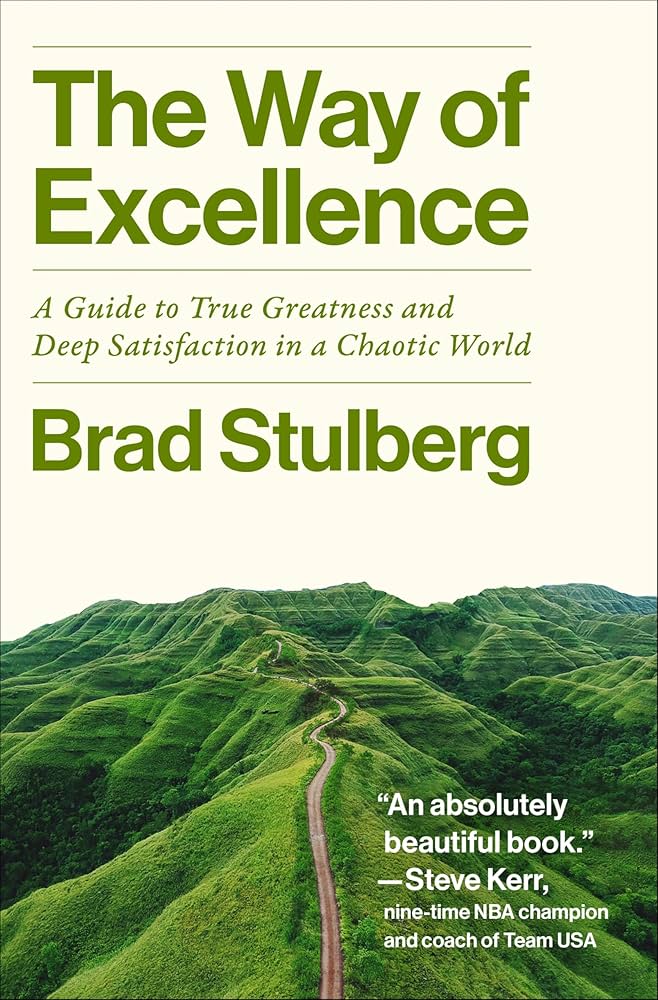
Brad Stulberg is a bestselling author, writer for The New York Times and Wall Street Journal, co-host of the podcast Excellence, Actually, and faculty member at the University of Michigan. His newest book is The Way of Excellence: A Guide to True Greatness and Deep Satisfaction in a Chaotic World.
In this episode, you’ll discover
- A powerful redefinition of excellence that frees you from perfectionism
- Why mastery and mattering are essential for deep satisfaction
- A simple way to reclaim focus in a world designed to distract you
- How joy, rest, and renewal fuel long-term growth
- A practical framework for balancing ambition with the rest of your life
If you’ve ever felt pulled to do meaningful work but exhausted by the way success is usually framed, this conversation offers a wiser, more human path forward. Press play to explore what excellence can become.
You can find Brad at: Website | LinkedIn | Episode Transcript
Next week, be sure to tune in for my conversation with Susan Piver about why love feels hard and how that discomfort can deepen intimacy. Follow the show in your favorite listening app so it’s right there when the episode drops.
Check out our offerings & partners:
- Join My New Writing Project: Awake at the Wheel
- Visit Our Sponsor Page For Great Resources & Discount Codes
Photo credit: Sandlin Gaither
_____________________________________________________________________________________________________
Episode Transcript:
Jonathan Fields: [00:00:00] So there’s this word that gets thrown around a lot. And for many of us, it’s become heavy or at the very least, loaded excellence. It can sound like pressure, like perfection, like hustle at all costs. But what if it’s not what excellence was ever meant to be? In today’s conversation, I sit down with Brad Stulberg to explore a far more grounded human understanding of excellence, one that’s not about winning or grinding yourself into the ground or being the best in the world, but rather about caring deeply, giving yourself fully to what matters, and letting the process shape who you become along the way. Brad is a best selling author, a longtime contributor to The New York Times, and the author of his newest book, The Way of Excellence. His work blends science, philosophy, and lived experience in a way that feels both wise and deeply practical. And in this conversation, we talk about how we’ve gotten excellence all wrong and a better way to think about it, and why attention is so hard to hold right now, and how that really hurts us, and why joy and rest are essential parts of growth and excellence, and also how the pursuit of mastering meaning work together with doing things purely for joy, to create a life that feels deeply alive. This is a conversation for anyone who wants to grow and create and contribute without burning out or losing themselves along the way. So excited to share this conversation with you! I’m Jonathan Fields and this is Good Life Project.
Jonathan Fields: [00:01:27] You and I have had a conversation before and I’m excited to dive in. The topic is excellence, and this is something I’ve thought so much about over the years I’ve explored. I’ve explored the research I’ve lived into in a lot of ways. I have done the exact opposite in a lot of ways, and I think so many of us have the word excellence to start with is an interesting word, and for some people it’s a triggering word. When you think about excellence, when we talk about excellence, what are we actually talking about?
Brad Stulberg: [00:01:59] We’re talking about involved engagement in something worthwhile that aligns with your values and goals. That’s how I define excellence. If you trace the history of the word all the way back to its genesis, in ancient Greece, the word was arete. It meant to live into one’s full potential. Why it is so triggering is what has happened over the last couple of decades is excellence has been appropriated to mean all kinds of things that it’s not. It’s been appropriated to mean obsession, winning at all costs, perfectionism. There’s also what I call bro excellence, or pseudo excellence or internet excellence. And this is needing to have a 47 step routine that starts at four in the morning, or needing to be a straight-A student on everything and run a five minute mile and deadlift more than your house and have a six pack of abdominal muscles. These things are not excellence. That’s like elaborate kabuki masquerading as the real thing. Real, genuine excellence means caring deeply about something and giving that thing your all. And in the process of caring deeply and giving it your all. The results take care of themselves and you shape your own character. You shape yourself as a person. So the woodworker might make this elegant table. The artist might craft a beautiful piece of watercolor. The athlete might finally run the marathon in under three hours, and those are all wonderful results. However, what’s also happening is that craftsperson, that artist, that athlete, they’re being changed in the process of pursuing excellence. What they work on is also working on them. That’s real excellence. It’s not getting all A’s. It’s becoming a better person by giving something your all.
Jonathan Fields: [00:03:45] I mean, that resonates so powerfully for me as we have this conversation. It’s about a month or so, actually, after I took the stage here in Boulder for a TEDx talk, and my talk was about why craft matters now more than ever. And the big idea that I shared is so spot on with what you just shared, which is that we don’t make things just to have them exist in the world. We make them because the process of creation changes us along the way. And I think we lose sight of that. It’s all about what am I accomplishing? What am I achieving? What am I making in the world? Rather than how is the experience actually affecting us? How is it shaping us? How is it making us, us in our lives better in some meaningful way?
Brad Stulberg: [00:04:23] That’s right. There’s a hypothetical that I like to use to really make this clear and imagine, and we’re probably not too far off from this, to be honest, Jonathan. But let’s just imagine that there’s a button that you could press, and by pressing that button, it would compose the most beautiful Grammy Award winning piece of music you could ever imagine. And you’d get the award. You’d get to go to the award shows, the song would be yours, and all you have to do is press a button. Would that be fulfilling to win that award? To have composed that, you wouldn’t have composed it, you would have pressed a button? The answer is no, of course not. What makes a beautiful piece of music beautiful is that the artists poured their heart and soul into it over weeks, months, in some cases, years. And that’s also what fulfills the artist. I think that there is something about watching a master at his or her craft that is irreplaceable by any kind of algorithm. So you watch Steph Curry play basketball, or you taste the creation of a master chef, you go look at a Rothko. In real life, there’s nothing in your mind that tells you you’re in the presence of greatness.
Brad Stulberg: [00:05:37] It’s a deeply felt thing. Maybe after you feel it, then you say, oh, Steph Curry is so great because the way that he releases the ball at the apex of his shot, or this piece of steak is cooked just right, and these are the tannins that pair with the wine and all this but all that is secondary to the feeling that you have. Like, you know that you are in the presence of greatness because you feel it. And that feeling is an utterly human thing. And I have yet to come across anyone that has had a manufactured creation, an algorithmic creation, an AI creation that has led to that feeling. They might look at it and say, that looks really cool. But that feeling is is missing. And I think that feeling is only possible when something is created by a human and then received by another human. And that’s another hallmark of excellence, is that at first it is pre-cognitive. It’s not an intellectual phenomenon. It’s something that we feel in our heart and our bones, and then we work our way into all the reasons it’s great in our mind.
Jonathan Fields: [00:06:31] I truly hope you’re right. I truly hope the human to human thing stays a part of it. And I guess we’re all going to find out over the next couple of years. Why does excellence matter to us? Why does the pursuit of excellence. I know you said, well, it helps shape us. It helps us sort of like experience the human condition. But can we live a good life without it? Without the pursuit of it, without experiencing it? Like, why is it important for us to have this in the mix?
Brad Stulberg: [00:06:57] I think it’s important for a couple of reasons. The first is that when you aspire toward excellence, you are filled with a sense of mastery, which is a term that psychologists use to describe the process of developing skill. The process of making concrete progress and getting better at something. And we know, thanks to decades of research, that that is a core human need. We need to feel like we’re making progress at something. It really fills our minds. It fills our hearts, leads to this deep satisfaction. The second reason is if you pursue excellence in the way that I define it, involved engagement in something worthwhile that aligns with your values and goals. You also have a sense of mattering, so you feel like what you’re working toward, what you’re doing, actually matters. It’s making some sort of difference. Maybe it’s making a difference to your community. Maybe it’s just making a difference to yourself. And when we have mastery and mattering, we tend to really embody our best feeling states. We feel like we’re in a groove. We feel like we’re in a rhythm. We feel content with life. I think most people have had the experience of having a day where, at the end of the day, your head hits the pillow and you’re just like, you know, if I died today, it would stink. I want to be around, but like, I’d be content. And the reporting of this book, when I asked people to tell me what happened earlier in that day, they were always using their own unique gifts and talents and pushing and exerting really good effort on something that they found worthwhile.
Brad Stulberg: [00:08:17] So if those are the days that really fill fill our hearts and fill our souls, then of course we want to have more of them. And that leads to this great sense of of resonance and aliveness. So that’s the first reason I think it’s important. And the second reason I think it’s super important is there seems to be this epidemic of nonchalance. And what I mean by this is it’s like this too cool to care attitude. So I’m just going to kind of coast through life. I’m not going to really care about anything. Um, trying hard is cringe. You know, that’s what the younger kids might say. And I think what’s ultimately happening here is that that is just born out of insecurity and a fear of stepping into the arena and caring deeply about something. Because when you step into the arena and you care deeply about something, there’s a chance that you’re going to fail and get embarrassed. And even if things go well, the deeper that you care about something, the more it breaks your heart. So what I mean by this is if you are parenting and you just care so deeply about your kids, well, if all goes well, at some point those kids are going to move out of the house and that’s going to break your heart.
Brad Stulberg: [00:09:17] If you’re an athlete and you give your all to your sport, at some point you’re going to age out and you’re going to have to retire, and that’s going to break your heart. If you’re an artist and you just pour everything into the painting, at some point that painting is going to be complete and the process is going to be over, and you’re going to have to grieve the loss of that process that filled you with joy. That’s going to break your heart. So the things that we care about are the things that fill our lives with meaning and joy are also the things that break our heart. So in some ways, it’s easier to have this nonchalance. Say, I’m just not going to really care. Like I’m too cool to care. I’m too hip to care. But while you protect yourself from heartbreak, you also don’t get to experience the fullness and the texture that comes with like, throwing your all into something. So I’ve come to firmly believe, and I’ve seen this in myself, that when we have mastery, when we have mattering, and when we are caring deeply about things, that’s when we are most alive. Doesn’t mean life is the easiest. I wouldn’t even say that we’re the happiest, but we feel the most resonance and aliveness, and we have the most meaning in our lives. And these are really important things.
Jonathan Fields: [00:10:16] I’m nodding along, but there’s also a really big question building behind me. What about parts of our lives where we do them simply for the experience of doing them? Parts of our lives where we do them because we’re pretty comfortable and pretty sure that we don’t have the innate talent. And even if we put in our thousands of hours of practice, we’re never going to become world class at them. We’re probably never going to actually develop a level of high level mastery. We do them purely because we just love the feeling of doing them, even if we never get really good at them. Shouldn’t there be parts of our lives where it’s not that we’re looking at those lives and its nonchalance, or we’re like, we’re making an excuse for not really trying, but aren’t there parts of our lives also where it’s actually not only okay to not pursue excellence, but it’s actually probably a good thing?
Brad Stulberg: [00:11:08] Yeah, absolutely. I mean, this is like me singing in the shower. I have a terrible voice. I’m never going to be accepted to any kind of choir. But I love music and I love to sing. But I would argue that it is still this like broader orientation that is attuned to excellence, that allows me to have those moments of enjoying music because I recognize excellence in others, and then I sing along and I have fun. Am I trying to be the best? But I really appreciate the beauty. I appreciate the art. I think often also what happens is in this dichotomy of like art and science, excellence takes on this rigorous, very linear, more scientific, classical view, and it gets separated from art. But I think the two are like very inextricably linked. And I think that a big part of orienting around excellence is it allows us to appreciate beauty and joy in art, even if we’re not trying to be good at something. Notice in my definition of excellence, I said, involved engagement in something worthwhile that aligns with your values and goals. Nowhere did I say you need to be the best at it. And I think what you’re pushing on is I did say like a sense of mastery is really important. And in some areas of our lives we absolutely need it. But in other areas of our lives, we ought to just do things because we love doing them and we enjoy we enjoy doing them.
Jonathan Fields: [00:12:19] Is excellence a destination or pursuit then?
Brad Stulberg: [00:12:22] I think excellence is absolutely a process. It’s a process of becoming. There are destinations along the way, but you reach the destination and then there’s the next mountain to try to climb, and there’s no such thing as perfection. You never attain excellence. I think it’s just this ongoing aspiration. It’s this ongoing North Star that then shapes your own, your own personal becoming. And that’s why it’s so important to align it with your values. Because like, again, you think that you’re working on the table or you’re working on the deadlift, but you’re actually you’re working on yourself. And ideally you’re doing it in a community of other people, and you’re forging really close relationships along the way.
Jonathan Fields: [00:12:58] And we’ll be right back after a word from our sponsors. So if we look at this and we say, okay, so excellence matters, it is a growth oriented process and growth along the path of something that genuinely matters to us, which I think we could probably all nod along. If I think about the areas of my life where I’m investing energy, I’m growing, I see regular progress, even if I’ve never become amazing at it or the best in the world. And it’s something that matters to me. I can’t tell you why it matters to me, but it just does. That feels good, and we probably all want more of that in our lives. Does modern life support our ability to explore excellence these days, or does it kind of do the opposite?
Brad Stulberg: [00:13:41] I think the default path is very much one of just kind of going through the motions and kind of being numbed to death. The book Brave New World by Aldous Huxley, I think, is sadly becoming more of a reality than many people would have ever expected in a part of the reason that Brave New World wasn’t a utopia, it was a dystopia is because there was no art, there was no excellence. Everything was just kind of on autopilot. And I think that in our own lives, the default is very much to go along this like algorithmic stream, wherever it takes us, just from one thing to the next. And to have so much distraction and so much noise that we don’t get the opportunity to care deeply and to get really close and to get intimate with something. That’s not to say it’s impossible. In a magic wand world. I’d wave my magic wand and there’d be some kind of perfectly concocted regulatory structure that would make it so more people could pursue excellence. I don’t think that’s going to happen, but I do think that we still have enough agency to be intentional and try to create the conditions for ourselves so that there are pockets of our own lives where we can pursue this sort of excellence.
Brad Stulberg: [00:14:45] And then because it feels so good, because it’s this like intrinsic reward, once we taste that intrinsic reward, it gets a little bit easier to lean into it more and more. But it’s hard. I’ll tell you this one story. This this made it into the book because it happened when I was reporting on the book. And it just goes to show how challenging it is in today’s world. So I’m pursuing my own version of excellence in my craft as a writer. I’m working on this book, and I’m in this incredible state. When you’re working on a big creative project where ideas just start coming when you least expect them, right? That’s the beauty of the creative process. And I was having this really busy day. I coached my son’s basketball team in the morning. I’m running errands. I’m going from one thing to the next, and I finally am in the car alone. I’m pulling up to a gas station and the light bulbs click. And now I have an idea for the seventh paragraph on chapter six of the book, and I go out of the car to fill the gas tank, and I’m like, I’m going to have two minutes of silence to, like, think through this idea. And then on the screen of the gas pump is this woman yelling at me to buy her Nicorette gum or Zyn or whatever she’s selling I’m now getting advertised to while filling my car up with gas.
Brad Stulberg: [00:15:54] It’s like there’s just so little time and space to get close to anything, including your own thoughts. And that is true. And what that means is, again, we have to be so intentional about creating those conditions where where we can have focus and intimacy and not just be so distracted all the time. Willpower is no match for these technologies. The only way around them is to try to design environments that are conducive to attention. And when it comes to the pursuit of excellence, that means leaving these hyper connected devices out of the picture. And I don’t mean that metaphorically. I mean that literally. And then that gives us a chance to settle in and to groove in and to have that attention in that care for what we’re doing because it’s impossible to have excellence, impossible to have a good life. Well, you’re alienated, like where there’s space between you and what you’re doing all the time. You have to care to have a good life, and you have to get intimate and get close to things. And that requires removing things that get between you and what you’re trying to do.
Brad Stulberg: [00:16:52] And you have to be so intentional about that in today’s world. What’s fascinating is that in the reporting process for the book, I talked to so many people, and I asked them about the times that they feel best and they feel most alive and without fail. They were either in the process of creating excellence. So using their full potential, working intimately on something that they care about or they were observing it, they were at a sporting event or a concert or an art gallery, and they weren’t distracted. So there’s still enough of our soul that realizes, like the path to a good life, the path to aliveness is to create this. It’s just the environment around us makes it harder and harder, and we have to be more aware of that and more alert to that than ever before. And like, we really have to design the environment. There’s a reason that in the chapter on focus, I spent very little time talking about mindfulness meditation and things that you can do to strengthen your internal focus. And I spent a lot of time talking about how do you take stock of your environment, and how do you try to design environments that are conducive towards intimacy and attention?
Jonathan Fields: [00:17:53] Yeah, and now I love that. And this notion also that excellence can affect us on two levels. One is our own personal exploration of excellence, but also being in the presence of excellence. And so many of us have been in that moment where I remember as an author, you know, reading a paragraph in a book and laughing and crying at the same time. And part of it was just because, you know, I read a passage that was so beautiful or so moving just really touched me so powerfully. But then there’s being an author also being somebody who writes. There was another part of me that was saying, Dear God, I know what it took to be at a place in your creative life where you can write something like that and move something like that. I had the beautiful chance to sit down with Ani DiFranco a month or two ago, and just before the day before I was hiking, and I was just listening to some of her old songs, and one of her songs came on and I found myself hiking and just weeping as I was walking. And I said to her, I said to Ani, I was like, Ani, you created something that does that to literally millions of people. Like, what is that like for you? And you’re so right. Like it is. It’s beautiful to actually be able to feel like you are in some way exploring excellence yourself. And we all know that experience of being in the presence, being touched, moved by something that was born of excellence. And it’s equally incredible.
Brad Stulberg: [00:19:16] Yeah. So I want to just pause and put a pin in that, because I think this is so important and it’s such a mission of this project, what you just described, that’s excellence. That is so different than where we started the conversation and what most people think excellence is. It’s not waking up at 4 a.m. trying to be perfect. It’s not a diet that is extremely restrictive. It’s not having, you know, the perfect report card. It’s like it’s being moved and moving someone. And I just think like it’s so important to reclaim that. So at least we know what we’re shooting for. At least we know what the North Star is. Now that we’ve done that, I’ll share a very similar experience. The track and field athlete Emma Coburn, steeplechaser. This is years ago. I think she actually lives in Boulder, or at least she did live in Boulder. I got to know her a little bit and she is training so hard for this world championship. The way that I approach my writing, it’s very much like an athlete training and it’s just like rep after rep, day after day, year after year. And like hopefully it clicks. And there was this one race where it just clicked for her. And I remember they showed a picture of her pulling away and winning this race. And then they showed her family and her little sister just jumping up and down screaming. And I saw this and I just started bawling, just weeping. And I’m not even a huge track and field fan. I don’t know Emma Coburn. Wow. But I know what it takes to give your all to something, to pour your all into it, and then to finally have it happen after so many setbacks and so many failures. And that’s it. That’s the point of it all. And the person that she became along the way. And I do think that a world devoid of that, a life devoid of that, it’s just not it’s not as good. We’ve got to fight for this. It’s like such a part of what makes life worth living.
Jonathan Fields: [00:20:52] That makes a lot of sense to me. Let’s switch gears and get a little bit practical here, because a big part of of this book is like, okay, so let’s talk about a toolkit here. So if we all nod along and say, okay, so this is interesting to me, this matters. I can see how maybe I’m not going to pursue every part of my life and say, like, this has got to be everything. But I would love to have pieces of my life moments in my life where like I am in this space of exploring excellence. How do I do it? What are the just the very practical pieces of the puzzle? We’ve kind of dipped into a little bit of these here and there, but sort of early in the toolbox, if I’m remembering correctly. You introduce it with really just this notion of you’ve got to actually care about this thing that you’re exploring, and on the one hand, you just kind of roll your eyes and say, well, duh, of course. But on the other hand, I feel like so many of us actually pursue something, invest, pour ourselves into it, spend sometimes years, you know, thousands of hours, sometimes a lot of resources. And at the end of the day, we’re doing it not because it ever emanated from something like from our own hearts or souls. It’s like we were following somebody else’s script. We really don’t care.
Brad Stulberg: [00:21:55] Yeah, that’s so unfortunate. And that’s such a common story. I think that you can get really good at something that way, but I don’t think it’s ever excellent because, like, it’s not born out of your own heart. So the question then becomes, well, how do you find the things that you want to care about? And here the research is pretty clear and decisive in that, is that it’s helpful to sample a lot of different things. So a period of exploration. And then once you find things that you enjoy that are a match for your skills, your unique gifts, your temperament. Then you want to go deep. So in the research, it’s called explore, then exploit. The way that I think about it is first you need fit and then you need grit. It’s okay to quit things if they don’t fit. But once you’ve found the thing, that’s when you need grit, and that’s when you need to dig in and be ready for setbacks. Another way to think about this is what lit you up when you were a kid. Again, you might not be world class at it, so growing up I was always an athlete, and then I kind of got away from sport because I wasn’t going to play in the NBA.
Brad Stulberg: [00:22:56] I’m six foot tall. I wasn’t going to be in the NFL. But now in my adult life, like the hobbies where I still pursue excellence, I’m not winning any medals. I’m not going to make a dollar from sport, but I’m still an athlete and I’m still becoming an athlete. And that’s what I loved as a kid. So many people can find their way back to music, to art, to crafts, to gardening. If like, you love to like, have your hands in the dirt as a kid, these are the things that we tend to want to care about. Like there was some inner spark in us when we were a child, before we had all the expectations of the world put on us, and before we had all these people telling us what we should do, we kind of knew what we wanted to do. And as adults, we can get back to those places.
Jonathan Fields: [00:23:33] And I think we always try. And it’s kind of funny because I feel like, you know, we spend the vast majority of our adult lives just trying to get back to the place and the feeling that we had when we were like nine years old. Yeah. Talk to me about trade offs also. This is something that you dive into and explore, and I think it’s something that we don’t talk about often enough because when you say, okay, so there’s this thing I’ve gone wide, I’ve like dabbled, I’ve played with a whole bunch of different stuff. Some of it I’m cool, just like having fun with. And then there’s this one thing and I want to go narrow and deep. I’m going to pour myself into it. I would love to feel like I’m really growing along that path. That really matters to me, I care. I’m working towards something. And you hit a point where you realize that to get where you want, even if it’s to get the feeling that you want, at some point you’re going to have to start to say no to a whole bunch of other stuff. And sometimes these nos are really big. You look at some of the earlier research on greatness, like Anders Ericsson and his whole notion of deliberate practice, which kind of got, you know, morphed, unfortunately, into the, quote, 10,000 hour rule. But I think a lot of people would know it from that. And when he identified this thing called deliberate practice, he’s like, this is not fun. This is thousands and thousands of hours of practice, which is focused, it’s iterative. And this is not a fun process. And it’s grueling for a lot of people. Not that everyone experiences or has to experience trade offs on that level, but talk to me about the notion of sacrifice or trade offs along the way.
Brad Stulberg: [00:25:04] I think the first thing I would say is deliberate practice is generally not fun, but it is satisfying. And I think that so often we might pursue ease or happiness in the moment, and we want to have moments of joy. Don’t get me wrong, but I think what most of us really want is satisfaction and and fulfillment. I think that that is a part of exerting effort on something that you care about is it might not always be fun, but it ought to be really satisfying. And if it’s not satisfying, then you’re probably not doing something that you care about to get back to square one in terms of trade offs. I think that on the one hand, yeah, at times you’re trading off acute ease for long term fulfillment because what you’re doing is hard and in the moment it might not be comfortable. You might have to make yourself vulnerable. But what you get out of it is fulfillment and satisfaction. Then there’s another trade off, which is a much more literal trade off, which is just there’s only so many hours in the day, and you only have so much energy, and there’s only so many things to care about.
Brad Stulberg: [00:25:56] And especially if you’re not going to be the greatest in the world at something, you’re doing this as a hobby. Or maybe if you’re getting paid, it’s a side hustle. So how are you going to make the time to do it? And the answer is you’re going to have to say no to a lot of other things to create the time and space to pay attention and have energy and get intimate with the thing. And for the longest time, we’ve been sold balance. And I think that the way that balance is at least popularly conceived is you’ve got to be a good husband, a good wife, a good parent, a good community member. You’ve got to go to church or synagogue or the mosque. You have to stay up on all the TV shows. You have to be in a fantasy football league. You have to listen to all the music. You’ve got to go to the latest movie. You’ve got to be on 19 group chats. You’ve got to throw the baby shower and on and on and on.
Jonathan Fields: [00:26:40] Sounds totally doable to me.
Brad Stulberg: [00:26:42] What ends up happening is this thing that’s supposed to be associated with well-being stresses you out. And what I argue in the book is actually, we shouldn’t strive for balance, at least not in that way. What we should strive for is the self-awareness to make trade offs, to allow us to pour ourselves into what we actually care about. And that doesn’t mean that we need to be obsessed. That doesn’t mean that we should blow up our marriage or our relationship with friends. But what it does mean is just acknowledging, and I think any mature adult has to do this, that we cannot do everything, given that we can’t do everything. What do we want to do? In as painful as it might be to leave other things behind? Eventually it’s freeing. And there’s this fascinating pattern that I’ve observed in people who have pursued greatness and have pursued excellence and who have done it the right way, is when you zoom in on any one moment of their life, they don’t look balanced at all. They’re going all in on like 1 or 2 things. So they’re starting a company, they’re training for a marathon, and they’re like, you know, they’re hopefully a good husband or wife or a good parent, but it’s really like a family in craft. And maybe it’s family craft and a hobby. But then when you zoom out and you look across their whole life, they actually look quite balanced. They’re also a gardener. At some point of her life, they had a bonsai tree habit. They learned how to knit. They got really into classical music. They traveled. But they’re doing these things in different seasons. So instead of thinking about needing to be balanced at one point of time and do everything always and be everything to everyone, I think it’s more helpful to think about making trade offs and then over the course of a life having different seasons to emphasize different things that matter to you.
Jonathan Fields: [00:28:14] Yeah. And this really brings in the notion also of of time horizons. You know, I feel like we have become such a culture of short termism. We focus on the short term allocations on what we’re doing. We focus on short term outcomes. And you’re right, any snapshot is going to show wildly divergent pictures. You know, it may show you completely out of whack out of it. You might look at a snapshot and say, oh, this is not okay. This is completely out of balance. You know, you and I have both written books. I guarantee you the final six weeks of every book I’ve ever written. If you took a snapshot at any given waking hour of my life, it would not be a picture of balance. You know, there are moments where you’re just pushing really hard to make something deeply, deeply care about that’s big happen. But like you said. But then you zoom the lens out to the movie of your life, and it’s like if you looked at all the snapshots along the way with the bigger thing, tell the story of, oh, yeah, I can see this sense of ebb and flow, like when I really zoom lens out, but we’re so focused, I think, on just this, this hot minute. And that affects, I think, everything when we optimize just perpetually for what’s right in front of us. That doesn’t necessarily mean the long term impact of that is optimizing for a life well lived.
Brad Stulberg: [00:29:31] That’s so well said, Jonathan. If you optimize for the moment, it’s going to look very different than optimizing for a life. And I think that if we can shift the time horizon to the longer term will be better off. I do think that even in those moments of dysregulation or unbalance, whatever you want to call, it’s really helpful to have minimum effective doses for areas of your life that you don’t totally want to let go of. So you might be in the last six weeks of a book and you might say, normally I exercise for 45 minutes a day. I’m going to still exercise. I’m just gonna do it for 15 minutes a day. I’m gonna do like a very short workout. Normally I have family dinners five nights a week. I’m traveling a lot, but I’m never going to go less than three nights a week for this period of time, because where people run into problems is when they let those things go completely. And then it’s a lot harder to pick them back up. Or sometimes they’re not there when you want them to be there when you return to them. The metaphor that I use in my own life all the time is it can be really helpful to think of identity like a house. And if you have a house and the house only has one room in it, and that one room catches fire or floods, you’re going to be in for a completely rude awakening.
Brad Stulberg: [00:30:36] You’re going to have to move out of the house. But if you’ve got a house with multiple rooms in one room, catches fire or floods, then you can go seek refuge in the other rooms. We should think about our identities the same way. So in my identity house there is a room. As a parent, there’s a room as a husband. There’s a room as a writer. There’s a room as an athlete. There’s a room as a friend, and there’s a room as a family member. There’s some other small rooms, right? There’s a room. As someone that loves music, as I said, I’m not very good, but I love listening to music. There’s a room, as someone that loves to go to coffee shops, just like these little parts of my identity, there’s a room that someone that enjoys his German Shepherd like, I love dogs. That’s a little room now, much like a real house. You don’t have to have the same size rooms, and you don’t have to spend the same amount of time in each room. So when I’m finishing a book project, I’m spending more time in the book room than any other room in my identity house, both physical time and emotional and cognitive time. But I make sure that the dad room and the partner room in the athlete room, I make sure those rooms don’t get moldy, because I know that I’m going to be spending a lot more time in them once this book is done, and I communicate with the people in those other rooms and I say, hey, I’m not going to be in this room as much as I wish I could be this month, here’s why.
Brad Stulberg: [00:31:45] But at the end of the month, I’m coming back to this room full time. And if I’m not, I want you to hold me accountable. So rather than strive for balance, I think it’s like, hey, what are the rooms in your identity house? What rooms are you spending a lot of time in right now? And how do you make sure that you never let other ones get moldy? And the final thing I love about this metaphor is much like an actual house, you can make additions and renovations. Maybe you had the football player room and now you’re 54 and you don’t really play football anymore. You don’t really like the sport. You can grieve the loss of that room, but you can also make that room into the Gardner room. It can change. And I think that this is just such a better framework for me and for so many people that I’ve talked to than one of like trying to balance everything always.
Jonathan Fields: [00:32:24] I love that metaphor of the house, and I also love the notion of the minimal effective dose. I’ve used that in so many different parts of my lives when I’m just like, and I think because we all know this experience of it’s so much harder to go from doing something minimally to doing to to sort of like bringing it back up to the level that you want to do it, than it is to go from zero to doing something. Whatever the inertia is there. It’s just it’s so much harder to go from a cold start to something than it is to go from something to something more meaningful. So this notion of just like, water it just enough. That’s right. So that it’s it’s not dying on the vine knowing that you’re going to get back to it and really take care of it, but just don’t let it completely go. And probably if we all thought about it that way, like we could find the time for that.
Brad Stulberg: [00:33:10] Yeah, especially because the minimum effective dose can be quite minimum. And I love what you’re saying. Like the way I think about it is it’s always easier to maintain than it is to rebuild. And often it doesn’t require much to maintain. So to get really practical, you’re in a season of life where you want to go all in on, let’s say it’s an artistic goal. Then define what do you have to do to take care of your health? Like what’s the minimum effective dose for exercise? If you have a family, how are you going to communicate with them? What’s the minimum effective dose for family dinners for going to kids sporting events, whatever it is, and then some time constraints to check in with yourself in three months, four months, five months down the road and then adjust versus the myth of the passionate artist that just says, screw my family, screw my health. I’m just going to throw myself into this book project or into this this sculpture that almost never ends well. Actually, I would just argue it never ends well. There’s so many modern figures that you can think of, inventors that did incredible things that then kind of got obsessed and lost their mind. Like that’s an all too common story.
Jonathan Fields: [00:34:09] It speaks to the the research on harmonious versus obsessive passion. Obsessive passion also, it’s like people think if you become utterly obsessive and pour yourself and make this one pursuit everything, that that’s the way to succeed at this thing. And the research shows the exact opposite. It’s like, no, when you actually honor the other parts of your life that matter to you to along the way, then when things get really hard in that one central area, which they always will, it’s the fact that you have this other scaffolding there to support you that allows you to keep going. And ultimately, maybe it takes you longer, but you get to the thing that you want to so much more frequently, you know? But it’s a little bit counterintuitive. And we’ll be right back after a word from our sponsors. Talk to me also a little bit here, because early in our conversation, you brought up this notion of excellence is not obsession. Excellence is not perfection. Excellence is not hustle culture. Talk to me about the relationship then between excellence, rest and renewal.
Brad Stulberg: [00:35:09] Rest and renewal is a huge part of being great at anything. Stress plus rest equals growth. Is the shorthand the easiest way to say it. So if you want to grow at something, you have to stress yourself. You have to challenge yourself. You have to expose yourself to some kind of stimulus, make yourself uncomfortable, but then you have to have a period of rest and renewal in order to adapt. This is 100% true for our bodies and perhaps the most salient. So you go to the gym, you train really hard, and then you need to rest. And if you trained really hard every day with no rest, you’d break down. You wouldn’t get stronger. So the way to make a muscle grow is you train it, you do those biceps curls, then you take a couple days off and then you go back and you expose that muscle to just a little bit more stimulus, and you just rinse and repeat. An exercise science is called progressive overload. What’s fascinating, though, is that research shows that our intellect and our emotional capacity grow in very much the same way.
Brad Stulberg: [00:35:59] We have to expose ourselves to challenges, but then we need to step back and take time to rest, renew and reflect. And that’s when the growth occurs. So if we’re just constantly pushing, pushing, pushing and we never rest, renew and reflect, eventually we’re going to burn ourselves out. We’re going to stop making progress. The way to continue to make progress over time is to go through these cycles of expose yourself, to challenge, do the hard thing, then step back, rest, regroup, reflect, learn, and then throw yourself back into the challenge. I think such a striking example of this is Lin-Manuel Miranda, incredible performing artist, writer of plays, now writer of Disney films. He says that the vast majority of his great ideas come when he’s on vacation, when he’s not working at all. So he has this cycle of like, throw yourself into a creative project, execute, then step away sometimes for weeks, sometimes for months, and then the next idea comes. And then throw yourself back in and then step away in. So many great creatives work like this cycles of intensity followed by rest.
Jonathan Fields: [00:37:00] That’s so resonates with me. I was recently catching up with somebody who hadn’t talked to in a really long time. And she’s like, are you working on a book now or are you writing a book now? And I said, well, it depends what you mean by writing. I was like, I’m always writing a book, but I’m very literally writing. I love that, but when I’m out hiking, I’m working on a book.
Brad Stulberg: [00:37:18] I was just gonna say, oh, we’re kindred spirits. I was just gonna say, like, I’m spending four months taking meandering long walks, and it’s probably the most important work I’m doing for my next book, even though I might not even know what the title or the idea is yet. Yeah, but it’s a part of the process. And that’s so different than hustle culture, which is like, go, go, go. Document, document, document every day must have an observable result. That’s internet excellence. That makes for a great ten second Instagram reel that might go viral with a bunch of bros, but that’s not going to make for great work or a great life.
Jonathan Fields: [00:37:48] Yeah, and inevitably and invariably also, I find that even when I’m deep into something, I’m really building and it’s taking shape and it’s really cool, and then I get to a point where I’m like, and so I’m in, I’m in the excellence bubble to a certain extent, I’m and things are flowing. I feel really good. Ideas are popping, language is forming and I’m like, this is really good. This is closing the gap between taste and expression that I strive so much to close. And I kind of think I’m there. And then what I’ve, I’ve developed the habit of doing is saying, okay, let me let this sit for a month. Yeah. If I have the time to do that, of course. But if I do have the time, I literally just completely step away. And that distance, which in my mind is also a practice of rest and renewal. It’s like withdrawing from the process and just resetting. And then I come back to it and I sit down, I’m like, oh, this is okay, but it’s not what I thought it was. And I needed, I needed to remove myself from it to really understand that.
Brad Stulberg: [00:38:47] The preach, I have no notes. I think that that’s spot on. I mean, I can tell a story with this very book. I had this this period where in so many ways the writing of this book follows that cycle. So, um, I hadn’t even finished my prior book, Master of Change, and I was on a walk on the Hominy Creek Greenway. I can remember exactly where it happened, where the idea, the stroke of insight for this book came. And I called my literary agent. I never do this. And I said, Lorrie, I know what my next book is going to be. The words that I use might mean something to people who have read Zen and the Art of Motorcycle Maintenance and Robert Pirsig. I said, I think Robert Pirsig was right in Zen and the Art of Motorcycle Maintenance, I think quality is like the ultimate factor that we should all be after. And I think that I should write a big book on excellence to try to continue this work and make it more accessible. And I think now is the time to do it. She’s like, that sounds like a great idea.
Brad Stulberg: [00:39:37] So then I step away and then two months later I do the proposal and I sell the book, and I sell the book as having six chapters. And this was an intense period of creative work. Like you mentioned, everything’s congealing. I’m in the excellence bubble, and I’m like, I’ve got it. This is the book, and my publisher thinks I’ve got it. They pay me a ton of money. They’re like, this is the book, this is great. And then I step away and then I come back two months later, I’m like, no, no, no, this six chapters nonsense. This book needs to be 20 chapters. They need to be shorter. It needs to be broken down. It’s completely different structure and it’s so much better. And if I was so concerned with needing every day to have this measurable output, this book probably wouldn’t exist, because I wouldn’t have been on that walk where I had the idea, and it certainly wouldn’t have been as good, because I never would have given myself the permission to step away and come back with fresh eyes and fresh experience and make it so much better.
Jonathan Fields: [00:40:25] Yeah, I think that that just lands so true to what my experience has always been, whether it’s writing or really anything, anything that I really care about, where I am pursuing, I want this to be good. I want this to be really good, and I want to become better. I want to grow through the process too. Like when I went back to that book, I knew at that point also, I said, the thing that I’m creating is not what it needs to be, but also the level of insight and depth of thought and craft isn’t where I want it to be. Also, I can do better. I can craft myself into a better version of this. Not because I have to, but because I wanted to. Because it was, like you said, not necessarily fun, but really satisfying to do that. And I was like, I’m not there yet. But now I could have looked at that moment and said, and just kind of given up and with a sense of futility. But like, I was like, no, like, this is another opportunity for me to step back into this and it’s going to be hard, and I may need to really do a lot of reworking and maybe even throw out a whole bunch of stuff, but I’m weirdly excited to do that.
Brad Stulberg: [00:41:28] Yeah, that’s the that’s what I was. I mean, it’s all the elements, right? It’s care. You have to care about it. And then it’s like this deep satisfaction that you get. It’s not fun, but it’s satisfying. It’s just satisfying to know that, like you’ve given something, you’re all.
Jonathan Fields: [00:41:42] Talk to me about the role of community also, because this is something that you write about that wasn’t immediately intuitive to me. I think so often we think about our own pursuit of excellence as a solitary pursuit, and maybe there’s a piece of that that is true. But there’s a bigger picture here.
Brad Stulberg: [00:41:56] Let’s see. I’ll start with some of the hard science, and then I’ll get more to what I would call the art, or the beauty or the spirituality of it. So the hard science shows that motivation is extremely contagious. So if you surround yourself with people who are highly motivated and highly driven, even if their goals are completely in a different field than yours, you’re going to perform better. This is why there are stories of so many Nobel winners in incredible scientists hanging out with athletes and artists and across domain. It’s not the talent, it’s not the skill, but it’s the motivation. It’s the energy. It’s the vigor that we know is contagious. So if you put yourself in communities of individuals who care deeply about things, whatever those things are, that’s going to rub off on you and it’s going to affect you positively. The second thing that the research shows unequivocally is that if we can engage in communities of practice, those can be with people who are shoulder to shoulder alive right now. But that can also be a lineage. You can also see yourself in a lineage of writers or athletes or artists or musicians. Again, it helps ground us and it helps provide us direction for our path and it helps us feel like we matter. Okay, so that’s the research side of things. The heart side of things to me is really clear, which is on your deathbed, you’re probably not going to remember winning the gold medal or hitting the New York Times best seller list, or getting the promotion to regional vice president, or the day that you hit 100,000 Instagram followers.
Brad Stulberg: [00:43:23] What you’re probably going to remember is that people who you worked with, and if you’re in a competitive pursuit, you’ll probably remember the worthy rivals, the people that you competed against. We are such social creatures. Ram Dass said it best like we’re all just walking each other home. If you’re going to spend so much time climbing these mountains and if it’s going to be hard, it might be satisfying. But if it’s going to be hard, why wouldn’t you want to do it with good people? And like, why wouldn’t you want to forge those relationships along the way? There’s a scene that I chronicle in the book the Detroit Lions, the football team, they won their first playoff game in over 30 years, the worst franchise in NFL history, and they finally won a playoff game in the locker room. After that game, the general manager, the head coach and the starting quarterback, they all spoke. The whole thing lasted two minutes. They said the word love seven times in two minutes. This is an NFL locker room. These are some of the biggest like certified badasses that you’re ever going to find. And what were they talking about? They were talking about love and how much they loved each other. That’s it. That’s excellence. I get chills just thinking about it. So to the extent that we’re going to create and contribute, if we can do it as a part of community and with other people, we get so much more out of it.
Jonathan Fields: [00:44:33] I think we’ve all experienced that. You know, it’s the joy of sharing something that you have done in community or in partnership with others. It’s the sharing part of it that often makes it just so juicy. And it kind of brings us to one of the later things, and one of the last things that you actually focus in, and it is actually the role of joy in this process. And I want to tease out the distinction between joy and fun.
Brad Stulberg: [00:44:57] All right. So then let’s start with a dichotomy between hustle culture greatness or pseudo excellence and the real thing. So a lot of hustle culture greatness is portrayed to us is you’ve got to suffer. It’s always really hard. And especially in more masculine areas of the culture, like you’ve got to be angry, you have to have a chip on your shoulder. You have to prove everyone wrong. That’s the path to greatness. And I had an open mind when I went into the research and I said, you know, there are people out there like David Goggins who are highly motivating. And Michael Jordan had a chip on his shoulder. What I found is that the vast, vast, vast majority of people who achieve excellence in their pursuit are wired the complete opposite. They’re wired more like Steph Curry, who slays the entire NBA with a huge smile on his face. Or like the ultra marathon or Courtney Dauwalter, the best ever long distance runner of either sex who just has such deep joy for her pursuit. And then what you figure out is even Michael Jordan, even Michael Jordan, he had this primal expression of joy whenever he slam dunked the ball, he had his tongue out. And who was Michael Jordan’s coach? Phil Jackson, who was known as the Zen master who brought compassion and joy. Michael Jordan didn’t win a single championship without Phil Jackson.
Brad Stulberg: [00:46:07] I don’t want to give Phil Jackson credit. Michael Jordan’s an incredible athlete, and I don’t know if he wins those championships without Phil Jackson to counterbalance him. So I think that pseudo excellence or the myth is that you’ve got to be angry and that’s just total BS. You’ve got to find joy in what you’re doing. And I think the greats do find joy in what they’re doing. I think what what ends up happening sometimes culturally is you’ve got people that prey upon. And again, I’m speaking to this especially like in an era where masculinity, people say it’s in crisis, people are lonely. I think what happens is you’ve got a certain kind of internet grifter that goes to men and says, the reason you’re so lonely is because you’re so great and you’ve got this untapped greatness, and no one can understand how great you are, and they’re just jealous of you and they’re angry. So you got to keep pursuing excellence and do it in isolation and be the alpha lone wolf. And it’s just bullshit. It’s just keeping people lonely so they can tune into your bullshit content when actual excellence is like, no smile. Have fun. Like you’re going to die. Yeah, like work hard, but, like, do it with a smile on your face. The myth of Sisyphus. I love this, right.
Brad Stulberg: [00:47:09] Sisyphus is condemned by the gods to push a boulder up the hill. And the boulder rolls back down. And then you push it up, and then it rolls back down. And there’s so many interpretations of this. But my favorite is the philosopher Camus, who says that we’re all kind of Sisyphus, right? We’re all just pushing boulders up a hill, and then the boulder rolls down, and we do this over and over again, and then eventually we die instead of being despairing about it. What Camus said is that a good life is learning how to push a boulder up the hill with a smile on your face. And I feel like that’s just so true. Life is freaking hard. We never arrive. Whatever goal you achieve, it’s never enough. There’s always the next mountain. It’s always going to be a challenge. But if we can find joy in the process. If we can push that boulder up the hill with a smile on our face, if we can have the deep satisfaction that comes of it, like that’s the point. Like that is the point of it all. That’s excellence. And that’s going to lead to our greatest contributions that hopefully affect other people and perhaps, if we’re lucky, even outlive us for a generation of our kids or our grandkids or whatever it might be.
Jonathan Fields: [00:48:04] And that feels like a fabulous place for us to come full circle. So I, as you know, I always wrap these conversations with the same question. I have a feeling you may have just answered it, but I’m going to ask anyway. In this container of Good Life Project., if I offer up the phrase to live a good life, what comes up?
Brad Stulberg: [00:48:20] Pursue excellence.
Jonathan Fields: [00:48:23] Thank you, thank you. Hey, before you head out, be sure to tune in to next week’s episode for our conversation with Susan Piver about why love feels hard and how that discomfort can actually deepen intimacy. Follow Good Life Project in your favorite listening app so that episode is right there when it drops. This episode of Good Life Project was produced by executive producers as Lindsey Fox and me, Jonathan Fields. Editing help by, Alejandro Ramirez and Troy Young. Kristoffer Carter crafted our theme music. And of course, if you haven’t already done so, please go ahead and follow Good Life Project in your favorite listening app or on YouTube too. If you found this conversation interesting or valuable and inspiring, chances are you did because you’re still listening here. Do me a personal favor, a seven-second favor, and share it with just one person. I mean, if you want to share it with more, that’s awesome too, but just one person. Even then, invite them to talk with you about what you’ve both discovered to reconnect and explore ideas that really matter, because that’s how we all come alive together. Until next time, I’m Jonathan Fields signing off for Good Life Project.