
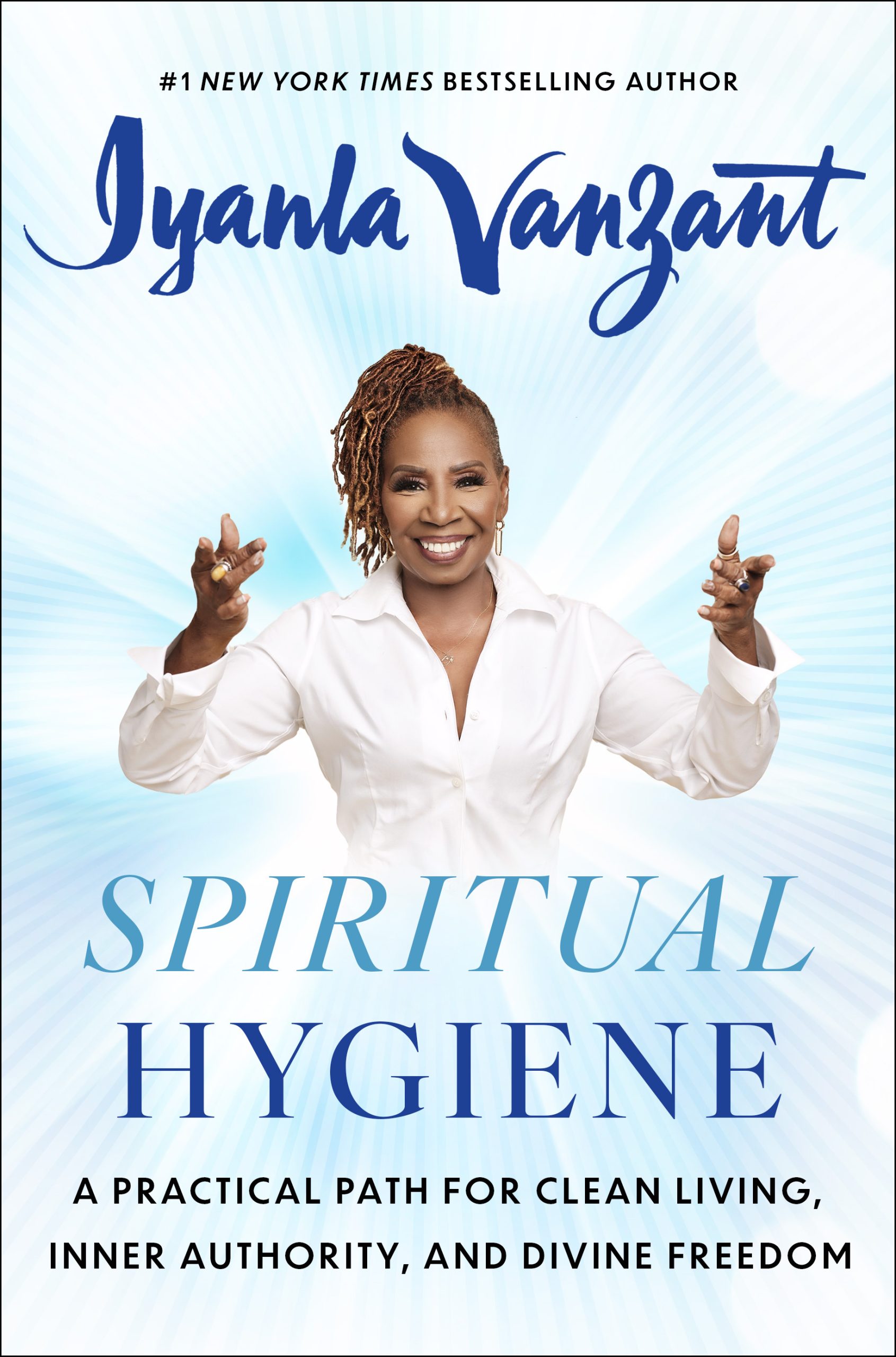
 From Public Defender to Spiritual Teacher. What happens when you walk away from a successful legal career with three kids, no backup plan, and only a deep knowing that you’re meant for something different? That’s exactly what Iyanla Vanzant did, following an unexpected spiritual directive that led her to become one of today’s most respected teachers of personal transformation.
In this intimate conversation, Iyanla shares the profound journey that followed her leap of faith, plus powerful insights from her new book “Spiritual Hygiene: A Practical Path for Clean Living, Inner Authority, and Divine Freedom.” You’ll discover:
• Why many of us are “spiritually congested” and how to clear the blockages
• Simple daily practices to process trauma and grief
• Her father’s three-word prescription that changed everything
• What it means to practice “spiritual hygiene” and why it matters now more than ever
• How to recognize when you’re using external things to fill internal voids
• The difference between grief as celebration versus mourning
Whether you’re navigating a major life transition, seeking to deepen your spiritual practice, or simply wanting to live with greater authenticity and inner authority, this conversation offers a practical roadmap for cleaning house spiritually and stepping into your full power.
This raw, honest discussion explores what it truly means to listen to your inner wisdom, even when it asks you to take bold leaps into the unknown. Iyanla’s direct yet compassionate guidance provides a blueprint for anyone ready to do the internal work of transformation.
You can find Iyanla at: Website | Instagram | Episode Transcript
If you LOVED this episode:
- You’ll also love the conversations we had with Thema Bryant about healing trauma and reclaiming your true self.
Check out our offerings & partners:
- Join My New Writing Project: Awake at the Wheel
- Visit Our Sponsor Page For Great Resources & Discount Codes
photo credit: Courtesy of iyanla.com
_____________________________________________________________________________________________________
Episode Transcript:
Jonathan Fields: [00:00:00] So we often feel exhausted. Not because life is so difficult, but because our minds are full of old wounds, unresolved feelings, self-destructive stories, and subconscious rules that just secretly run the show and leave us empty. Today I’m sitting down with Iyanla VanZant, the New York Times bestselling author of 19 books with more than 10 million copies sold, and the host and executive producer of the television series Iyanla Fix My Life. Her newest book is titled Spiritual Hygiene, and we’re exploring a radically practical idea. We talk about really daily simple habits and practices that help clear emotional residue, how unseen inner rulers like fear and shame shape our choices, and how to reclaim inner authority without fixing or forcing what hurts. We also explore why so many of us feel spiritually congested, and what it really takes to clean from the inside out in a way that’s gentle, honest and sustainable. If you’ve ever sensed that something inside feels crowded or noisy, even when it looks fine on the outside, this conversation offers a different way in one that restores clarity and agency and peace by listening more deeply to what is already there. So excited to share this conversation with you! I’m Jonathan Fields and this is Good Life Project.
Jonathan Fields: [00:01:30] I realize that you and I have an interesting shared background in very past lives. We apparently both went to law school in New York in the late 80s, practiced for about three years. I think you were in the Philly public Defender’s office. I was actually at the SEC in New York. Okay. And then had this awakening that said, maybe this isn’t the right path for me. So I’m really curious what happened for you in that time that kind of made you say, this just isn’t right for me.
Iyanla Vanzant: [00:01:59] Yeah, well, I was doing criminal law, so I was in and out of jail every single day. And I learned that I think the prison or jail is the one place on the planet where there is no love. There’s not a frequency of love. There’s not a vibration of love. There’s nobody is loving anybody in the prison. And love just isn’t there. So that was the first thing. So that kind of threw me off balance. But for me, it was really a spiritual director. I went back to my office one day and I couldn’t get the lights to come on in my office. And I told my secretary, I said, send somebody up to see about my lights. My lights won’t come on. And she came in the office and she said, she flipped the switch. She said, something must be wrong with your eyes because these lights are working fine. And in that moment I heard leave here and never come back, and I did. I went on that day. I never went back. I don’t have I didn’t have my law degree, my honey, my tea, my pencils, nothing. I left and I never went back because it was clear to me that that was not a place where I could experience or give or share love.
Jonathan Fields: [00:03:14] Hmm. Was it just crystal clear? And you never looked back? Or were there, never looked back?
Iyanla Vanzant: [00:03:19] Really never looked back. You know, I was well into my spiritual journey at that time.
Jonathan Fields: [00:03:23] Yeah.
Iyanla Vanzant: [00:03:24] And so I could follow guidance. I was learning about obedience. And I had three children and a cat and no job, but I knew, I just knew. But what I had learned, Jonathan. And this was it. You know, in the days that followed, when I’m really trying to figure out, oh my God, what have I done? Do I need to go back? What I got very clearly was I didn’t go to law school to learn man’s law. I went to law school to do two things to develop my mind, because I did not have a well-developed mind, and two to understand the distinction between man’s law and God’s law. I got that was very clear to me, and I didn’t know what I was going to do about it, but those two things were very clear.
Jonathan Fields: [00:04:13] Yeah. So when you wake up the morning after you decide I’m leaving this thing the next morning, you open your eyes. You’ve got three kids. You got a cat. Um, do you have a plan?
Iyanla Vanzant: [00:04:25] No. Who has a plan? Absolutely not. I had no plan. None whatsoever. Um. And really, in that period, that’s when I wrote my first book, Tapping the Power Within. And this is what happens, you know, when you’re on purpose, Jonathan, things just line up. It’s an elegant, graceful unfolding. So, as any good author, back in the 80s, I went to Kinko’s with my book and self-published it. I went to Kinko’s and self-published it. There was a a woman who worked in there who helped me lay it out. It was amazing. So I self-published my first book and sold it out the trunk of my car.
Jonathan Fields: [00:05:08] That’s amazing. And so tell me about what unfolded from that. I mean, was this a sort of a slow build? Did did something happen that made it catch?
Iyanla Vanzant: [00:05:18] Yeah. Um, I would sell it on consignment to small bookstores. I was living in Philadelphia at the time, and there were a number of them that would take 10 or 12 copies from me, and they would sell it, and I’d go back a week or two later and pick up my money, you know, for my, my $10. And, uh, then they talked to some sellers in New York and New Jersey. So the book started moving. Someone I don’t know who saw it, got it. And a publisher in New York called me, uh, and said they wanted to publish the book again. When you’re on purpose, when you’re aligned, everything unfolds. You can’t orchestrate it. And they published Tapping the Power Within. That was in 19. I don’t want to talk about it. Don’t make me talk about it.
Jonathan Fields: [00:06:08] So. So as we sit here having this conversation, you’re now 17, 18 books into your writing career, is that right? Somewhere around there, 19. 19. Right. And I guess the new one would be, um, and having sold more than 10 million copies of books when you first did that deal where you like, you took that very first book and you signed with a a New York publisher in your mind, in your heart. Was there any sense what would unfold over the next couple of decades would unfold?
Iyanla Vanzant: [00:06:40] None whatsoever. I did tapping the Power Within, and I put that out and I did some book signings and then Marie Brown the same agent, said that Simon and Schuster wanted a book to support people of color dealing with stress. Would I be able to write the book? Uh, yeah. Uh huh. Absolutely.
Jonathan Fields: [00:07:04] Have some experience there. Yeah, right.
Iyanla Vanzant: [00:07:06] And so that they contracted me for acts of faith. Um, and I always write to the title I learned back then. I get my title. I don’t know what’s going in the book. I get my title, and then it just it unfolds in me, through me, as me. So. And I still. I had no idea. None whatsoever. Um, I mean, I had so much help and support along the way from on high. And personally, after I wrote, I think acts of Faith was out. Doctor Dennis Kimbro, who wrote Think and Grow Rich A Black Choice. He inherited the manuscripts of Napoleon Hill. He was one of the people that Napoleon left his manuscripts, too, and I met him. We were in the Washington, D.C. conference center. He said, come here, come here. I didn’t know him. He said, come here, come here. He said, I want to tell you something. Specialize, specialize. Don’t just write books. Specialize. Figure out. Are you a teacher who writes or a writer who teaches? That’s what Doctor Dennis Kimbrough said to me. And I blew my mind, and I said, okay. And I took that in, and I worked with it. I chewed on it, I sat with it, and it came to me very clearly. I’m not a writer who teaches. I’m a teacher who writes. What I write is the curriculum that I’m teaching at a particular time.
Jonathan Fields: [00:08:31] Yeah, I love that framing. And that’s a question that I think so many folks who write and who feel like they have something to say. It’s such a powerful question, because I don’t think many of us ask that question. Yeah. You know, like, what’s supporting what very often.
Iyanla Vanzant: [00:08:47] And I get it all the time. I’m sure you do. People say, I want to write a book. I want to write a book. I said, okay, so sit down and write a book. But but I want to know, I need what do you need help doing? Do you want to write a book, or do you want to write a best selling, highly acclaimed book? What do you want to write? A best selling, highly acclaimed book. Why? What’s that intention? What’s that motivation? And that usually sends them screaming from the room. I never had an intention to write a best selling book, because I think by the time I wrote Faith in the Valley, which was my third or fourth book, I realized I wasn’t even writing for the people. I was writing for myself. I was trying to heal myself, and if they got healed in the process, good for them. But I was really writing because that’s my purpose. I’m a teacher who writes, and I needed those curriculums.
Jonathan Fields: [00:09:40] Yeah, that makes so much sense. So as we sit here in this conversation. Um, we’re having this on the eve of your new book, Spiritual Hygiene, coming out. Let’s talk about the phrase itself, spiritual hygiene, because this is interesting. Yeah. Take me into this.
Iyanla Vanzant: [00:09:55] People are spiritually congested, spiritually constipated, spiritually contaminated because we have been so programmed, conditioned, taught now to do everything externally. Everything is external. We look out for everything. Even if you want to get some information from my dear friend Professor Google, you got to go out. You know everything is out. And so we we are spiritually congested. Um, and again, some people contaminated, which means that we are not aware of aligned with using our innate power as divine and noble beings of the creator. We’re codependent on something outside of us for everything. And I’m concerned. I’m very concerned that with the way things are unfolding and developing in the world, if people don’t get back to their self, to their center, to their truth, to their power, that many, many people who have great gifts and things to share are going to perish because they don’t believe they can do it anymore. Uh, I saw it during Covid. Um, the way people were just the hair was on fire because they had to be still for five minutes. Um, and then what happened? Uh, I saw it just recently. And the government shutdown, um, the depth of despair because people work experience had shifted. I had to tell a friend of mine, you act like that job is your source. That job is not your source.
Iyanla Vanzant: [00:11:46] It’s a vehicle. It’s a it’s a way that the source gets to you. Um. And people don’t think like that anymore. It’s so dependent on everything external. Um, and that makes us kind of dirty inside because it’s a it’s a practice, you know, we’re committed to brushing our teeth, putting on deodorant, combing our hair, you know, put whatever we’re doing. We’re committed to that and we do it. You know, people have their their barber appointment every 2 or 3 weeks. The nail appointment, their their pedicure, their their, you know, wax the hairs off your chin or whatever. But they never stopped to say, have I processed the upset I had when my sister five years ago? Am I really clear about how I feel about my father, who left 20 years ago. Am I still hating my ex? And we’ve been divorced ten years. You know, we don’t process that stuff. We don’t process. And now, because of the language, everyone has a trauma response. And that’s where they leave it. Or that’s my trauma response. You in the streets screaming at people on the highway like a park ape. You got to do something about that. You can’t just say that’s your trauma response and leave it. So that’s what the hygiene part of it. Spiritual because it’s within, not without.
Jonathan Fields: [00:13:16] Hmm. And we’ll be right back after a word from our sponsors. One of the things that you explore early on is this notion of, um, us having an internal throne who sits on that throne for most people.
Iyanla Vanzant: [00:13:33] Fear the past. Unforgiveness, unworthiness. For most people, we’ve acquiesced our throne to what I call in the book illegitimate rulers. You know, fear of failing, fear of not. It’s not going to happen. And along with fear comes doubt. Um, unworthiness. I don’t deserve it. I can’t have it. Unforgiveness. Oh, Lord. Unforgiveness. Those things sit in the throne because again, we haven’t processed out, cleaned up the experiences attached to those emotions that give them permission to exist within us.
Jonathan Fields: [00:14:21] Um, and I guess the the risk here is that when they sit there long enough, they cause harm in all sorts of ways that we often don’t associate with them sitting there. I mean, this also probably leads to the conversation around what you call spiritual smog.
Iyanla Vanzant: [00:14:38] Yeah, spiritual smog, because after a while you you can’t hear. Let me give you a classic example. I grew up as a as a chubby kid. At least I thought I was chubby. I grew up as a chubby kid well into my adulthood. I always thought that I was chubby, I always thought I was fat, I could not see myself. And, you know, I’m in a size ten or size eight, 12, whatever. And I’m still seeing myself as fat because I had never processed out what it felt like to be called fat, chubby, big as a child. So that was in my throne, and it became the filter through which I saw everything. Uh, my grandmother had a saying for me. She said you were bad to the bone. You’re just bad. Bad to the bone. And so I grew up thinking I was bad. Everything was bad. And here’s the here’s the I call these cooties, these thoughts that are in there chewing on our brain when that thought is in the throne and when it’s playing out, you will do things unconsciously to make it right. You will engage in behaviors or practices, or you will behave in ways that make that thought accurate. See? I told you you were bad. See, I told you you were fat. So you go in the store and you have this beautiful dress, and they have it in every size but yours because you’re fat, you know, or you have an outbreak in, in the, you know, the church or funeral, and everybody’s looking at you like you’re crazy because you’re bad, you’re bad. Whatever it is, we don’t understand how those thoughts then become the filter through which we see and behave.
Jonathan Fields: [00:16:29] Yeah, and it becomes a Self-reinforcing mechanism that says whatever that negative message that you were past, that you associate with yourself, rather than just looking at any experience that we that happens around us as neutral, um, we just adopt the story that reinforces the negative message. And, and I guess the real risk here also is, you know, you keep hitting repeat on that. Yes. And it turns from a story into identity.
Iyanla Vanzant: [00:16:57] Yes. You got it. You must have read my book. Know who.
Jonathan Fields: [00:17:01] Knew?
Iyanla Vanzant: [00:17:03] Yeah, absolutely. And that’s why we have to do the hygiene. Because so many of us now have a false identity. We’re living way beneath the truth of who we are. And again, we’re codependent on external things that really don’t reinforce the truth of who we are.
Jonathan Fields: [00:17:26] Mhm. So to get to the truth of who we are, then, um, we really need to start with being honest. Um, you know, and this is the mirror that you talk about. Yeah. So how do we do that? Because I think we’ve all heard. Well, you know, the first step is to actually own the reality of where you are. Own the truth. Yeah. Um, but I think a lot of us, we’ve heard that we probably nod along and say, well, yeah, sure, that makes sense. You know, if I’ve got a problem first, I’ve got to acknowledge I have a problem or if there’s something if there’s a story I’m telling myself that’s harmful to myself, I’ve got to actually acknowledge, how do we actually explore the act of self-honesty with integrity and also not rationalize or minimalize or sort of spiritualize away, um, hard things at the same time? Yeah.
Iyanla Vanzant: [00:18:19] I think the step before we can be honest is to be aware some of us are not even aware of how crazy we are. And I don’t mean crazy in a bad sense. I mean, you know what? Our what our habits are, what our behaviors are, what our quirks are. We have to become aware. Um. And you know how you become aware. The thing that scares the blazing bejesus out of most people. Be still. Breathe. Just be still. Sit down. Ask a simple question and wait for the answer to come forward. That is so hard for people to do in today’s world. Just be still. And then when it comes up, to be honest about it. Not to excuse it away, not to excuse it, not to suppress it, because all of us have the things we have to face about ourselves that we’d rather not see or know. The cooties. Everybody has cooties. You know I have a thing. Call a thing a thing. Call your ugly, ugly. Call your mean mean. Call your anger. Anger call, call a thing a thing because everybody’s got a thing. And then once you see the thing and you call it what it is, you become aware of it. Now tell yourself the truth about it. And one of the truths is it came to teach you it really did. You have to ask. It came to teach you. Here’s a here’s a thing.
Iyanla Vanzant: [00:19:50] So I learned and this was, I’d say maybe ten, 12 years ago, whenever I’m feeling depleted or or empty or I, I’m clear about those things. You know what I do? I spend money, I go shopping, and I buy stuff, like to fill the void. So one day I was cleaning out my closet because I just had no place else to put. Nothing else I was buying. Jonathan, I had two and three of the same thing with the tags hanging on it. Had never worn them. Sweaters. Jackets two and three. Not just one, 2 or 3. I said, well, at least I’m consistent in my crazy, you know. And I had to sit down and. Okay, what is this? What am I doing here? But I wasn’t even aware that I was doing it. So I couldn’t look at it and tell myself the truth about it until I became aware of it. And I had to come up with something else. And it was a simple thing. When I just go shopping without an intention, before I buy anything, I would stop and ask myself, why are you buying this? Why are you buying this? Do you want it or are you filling a void? And if I found that I was voided or overwhelmed, I wouldn’t get it. I wouldn’t buy it. I’d have to go home and do some work. Simple.
Jonathan Fields: [00:21:26] Yeah, we all have our version of that, right? Yes. For you, it might have been purchasing things for somebody else and maybe eating for other people. It may be substance. Um, but you’re tying it back to this notion of the first step is awareness, though, right? Because you can’t even know to ask that question in until you have a mechanism to kind of stop and just ask the awareness question, which for you was, why am I buying this for somebody else? Might be, why am I eating this? Why am I drinking this? Why am I staying in bed? Like, why am I? Um, so it’s an interesting prompt. I think maybe just to offer out to everyone is to ask the why am I? Dot dot dot when you’re doing something that may actually be serving as, on the one hand, a coping mechanism, but on the other hand, a distraction from you sitting with something that is never going to be processed in a healthy way until you actually deal with it.
Iyanla Vanzant: [00:22:21] And and an even deeper question is, and I would ask myself this too. What am I feeling right now.
Jonathan Fields: [00:22:28] Mhm.
Iyanla Vanzant: [00:22:29] And that’s where people really get stuck because most people are emotionally illiterate. They know happy sad. They know angry. They know, uh, peace maybe. But there is a wide range of emotions that people are totally illiterate about. We’re emotionally illiterate. We don’t know. We can’t tell the difference between anxiety and gas. You know, you don’t know what you’re doing. So what am I feeling right now? And then trace that back. You know, this thing that happened at work today upset me or whatever it is. And then if you ask the why am I buying? Why am I eating, why am I laying? Why you’ll probably get to because I feel so and so. Then you can take that feeling down. And and the good news is that we’re living in a time right now. I’m sure you know this, Jonathan, where it can happen so quickly. The energy, the frequency of the universe is moving so quickly. It doesn’t take ten years of therapy anymore. You don’t need five crystals rubbing on your head. You know, you can affirm. You can decree. You can declare. You can choose just that quickly. So that’s the good news.
Jonathan Fields: [00:23:44] Hmm. So when we hit that moment, um, and we wake up to the fact that, oh, like, this is there’s something else going on here. Um, and we want to start to do things to unwind. Whatever it is that we’re feeling, the feeling underneath the. Why. Right? Um, a lot of it is going to tie back in some way to. Okay, so something happened to me, or I did something or there’s something in my past that has that’s staying with me. You mentioned earlier this notion of trauma that I think so many of us, the word trauma has been normalized capital T trauma, small t trauma to a point where we all feel like on some level, we’re just walking around with various varying bundles of trauma, and we probably are in some way, shape or form. The question, though, has always been for me, well, like, okay, so what do we do with that? You know, and how does the notion of spiritual hygiene help us process that so that we don’t keep going back to this same other unhealthy coping mechanism over and over and over, often, as you referred to earlier, something external to deal with, something that’s internal.
Iyanla Vanzant: [00:24:52] Well, one of the things we have to understand is trauma is a sudden, unexpected shock to the system, to the body that leaves an imprint. And sometimes there’s recurring trauma, you know, whether it’s physical abuse in in spiritual hygiene, I talk about poverty as a trauma, neglect as a trauma, hunger as a trauma, because some people have had those things that weren’t even classified as trauma, and they’re responding to it in a certain way in their life today because they’ve suppressed it. Some of the things we inherit, some of us not even ours. Uh, and that can be guilt, that can be shame, that can be poverty, alcoholism. So what spiritual hygiene does, first of all, the committed daily practice or action of cleaning up the inside simply with breath, with stillness, maybe journaling, maybe inquiring within simple daily practice, it begins to loosen up the strings that that keep those things in place. It begins to excavate the illegal rulers, the illegitimate rulers from the throne, and things begin to get clear. And again, you don’t have to, you know, drag yourself through the mud anymore.
Iyanla Vanzant: [00:26:16] It can be a simple sexual abuse, sexual abuse, trauma, physical trauma. I had them both physical trauma and sexual abuse. Trauma, abuse, trauma, negligence, poverty. I had them all. So I was a walking trauma factory, you know. And each of them motivated a behavior. So when I became aware of the behaviors, then I could address the trauma. And sometimes it was simply as simple as forgiveness. Sometimes it was just that simple. Sometimes it took a little something a little deeper. But we have the power to do that. We have the right and the inherent power to clean our spirit and our soul. And one of the things that I talk about in the in spiritual hygiene is my daughter Nyssa, who practiced very poor spiritual hygiene because that’s what I taught her, and that’s what she inherited from me. And as I evolved and and and grew, I could see in how she was living that that was my stuff. How she responded to it was one thing, but I could see very clearly my stuff on her.
Jonathan Fields: [00:27:41] Yeah, I think probably any parent or anyone who’s been in any sort of parenting role, um, often sees that in the next generation, because we’re all just doing the best we can at a given time, like nobody’s perfect. Yeah.
Iyanla Vanzant: [00:27:58] Earlier you said, you know, we want to know what to do, and I want to I want to encourage people to first be with the thing. So you do, let’s say you do the 20 minutes of writing or you have the awareness. Be with it. Don’t try to fix it. Don’t try to change it. Just be with it. Hold the thought. Allow it to bring impressions and visions to you and that will stir up in your body everything associated with it that you can then release, forgive, wash away. People would would be surprised at how profound it is to wash your hands of something. Literally put your hands in the water, get your little soap and I am releasing the need to. I am releasing the habit of I am release and let that water run over your head. Unbelievable. Another one. This may be a little gross for people, but one of my teachers taught me this many, many years ago. When you sit down in your bathroom to do your business, put your hands over your head, palms facing each other, and I release, I release, you know, anger, I release shame, I release the need to defend myself, I release, I release as you’re releasing release. Because everything begins with a word. Simple things that we can do.
Jonathan Fields: [00:29:29] And we’ll be right back after a word from our sponsors. I mean, it brings up another interesting issue, and this is one of the things that you write about, which is when what we’ve been holding often for so long, for years or decades becomes such a part of us that it becomes a part of our identity, even if it’s causing us pain on a regular basis and we’re in deep need of healing. It’s a part of us. And if and when we come to that moment that you describe where we first sit with it, we become aware of it. We sit with it, um, we create whatever ritual is right for us to start to release it there can be this weird grieving experience. You know, there’s there’s a there’s a loss that we can feel. And I wonder whether there’s a voice inside of us that says, I don’t want to feel the grief of losing this part of my identity, so I’m going to hold on to it, even though I know it’s causing me pain. How do we move through releasing and and and move through the grief that often comes through releasing something that we even we know is, is, is not for us and is holding us back.
Iyanla Vanzant: [00:30:38] I do a whole, I think, chapter and a half on grief. Grief is celebration. Grief has release. Grief is such a holy process. It’s an initiation. It is a clearing. It is a gift. Because the one thing that grief does, whether you’re grieving a thing or a person or a situation, it teaches you how to love differently. Grief does that. So we have to be willing because most of us run from grief. We don’t want to feel it. We confuse grieving and mourning. Mourning is a much heavier energy where there’s a lot of regret and remorse and sometimes resentment in mourning, whereas grief is a natural, organic process. And it will come and it will go. But we don’t want to feel that we were adverse to, because sometimes it’s so deep, particularly when what you’re grieving is a part of. You. And I talk about that in the book, my different identities that I had to mourn, I had to let go, and what I was moving into. So when we learned to see grief differently, when we learned how to handle it differently, approach it differently. You can release your old self, your little girl. You can grieve that. Your teenager. You can grieve that. So I want to just invite us to see grief as an initiation and a healing process, rather than as this thing that’s going to suck us into a black hole that will never come out of because, um, you’ll learn how to love you differently.
Jonathan Fields: [00:32:27] Um, is there a a question or a prompt or an invitation that might help us start to see grief or process it differently?
Iyanla Vanzant: [00:32:37] Well, there there are a number of them. One of the things that I ask myself when I know I’m grieving something, or it’s time for me to let something go, but particularly in grief. And I had to do this with my daughter Nisa. When she passed, I had to ask myself, okay, what are you holding on to? What are you holding on to? And what I realized with her was I was holding on to the belief that I had done something wrong. I’m the mama. My baby should not be dying. I also, uh, recognized that I was holding on to the grief that I had failed her in some way. So those were things that I was holding on to that had nothing to do with her. That was my stuff. And I think sometimes if we ask ourselves, what am I holding on to that will come up? I just did some work with a woman recently who had lost her mom, and she was holding on to the pillow that her mother had on, and and every time she saw it, she would cry. And I would say, okay, so tell me what those tears are. And she said, gratitude. And I was like, wow. Would you tell your face That you’re grateful that you have this memory, because otherwise, the fact that you’ve tied this gratitude to the fact that your mother’s not here, you won’t even recognize the. The blessing of the gratitude that you have. You’ll think it’s something dark and bad because she’s gone. That’s going to pass. That’s going to pass. The the physical missing in your. It will pass. I know people think it won’t, but it does. But ask yourself, in the midst of that, what am I holding on to even when it’s a part of you? What am I holding on to?
Jonathan Fields: [00:34:35] Hmm? Yeah. It’s a powerful question. You you also brought up in that story of your daughter, um, this notion that you were asking yourself, you know, like, you sort of, like, took on the blame, um, like, what did I do wrong here? And, and this is one of the things you write about also is this notion of spiritual responsibility. Like where is the line Between what I legitimately take ownership of and what is actually not mine to own, and even of the things that I do own. How do I do that without shame?
Iyanla Vanzant: [00:35:10] Um, good. That’s a good one. Yeah. Well, when you own your stuff, you know, when you take it on and you own it, no blame, no shame, no regret, no remorse. And the way to cut through all of that, what was I learning? What was I teaching? And again, all of this stuff takes us back inside. You can’t get these answers outside. What was I learning that supported this behavior, this choice, this way of being? What was I teaching that supported this choice, this way of being? What was I teaching? What was I learning? Simple questions that we ask. Uh, and when you do, things begin to come. The cleaner you are on the inside. So if you’re doing your daily breathing, your daily stillness, your daily silence, you’re stretching, bending whatever it is, drinking water, whatever it is that you’re doing, the answers will come clearer and they’ll come quicker, you know, because once you own it as a mom, for example, and I talk about this in the book, I’m very clear. Certain things I passed on to my children, poor spiritual hygiene was one of them.
Iyanla Vanzant: [00:36:23] Poor spiritual hygiene and and a low self worth, a self esteem. And then as I shifted and tried to give them the information, it was not my responsibility that they did it or take it on, took it on. It was their responsibility. And I think sometimes, particularly as moms, we want our kids to get it because we got it. And that doesn’t mean that it’s for them to get and we have to be okay with that. I write about in the book that I didn’t even go to my daughter’s funeral because my grandson was just unsafe for me to make that choice, to take care of me first, as opposed to following the tradition. And I got, no, I don’t have to be there. I do not I’m not going to put myself in harm’s way. And I had to own that. Part of the reason he was the way he was, was because she was the way she was. And I own my part of that. But I wasn’t going to stay stuck in it.
Jonathan Fields: [00:37:27] Yeah. I mean, complementing that also for you to be able to actually own that is also a sign of you understanding your own center. A clarity around like, this is who I am. This is the ground that I stand on, and this is the spiritual space that I inhabit, the presence that I inhabit. And also this is who I am not and what I am not open to bringing into that center. Um, and again, these are things that you’ve spoken about and you write about, um, something where again, somebody hears, you know, phrases like that find your center, like find the thing that keeps you steady. And everyone nods along and says, well, sure, that makes a lot of sense, right? And then and then some version of I wish I could do that too. How do I do that? How do I do that? Like they can’t wrap their head around how do you actually make that real in your life?
Iyanla Vanzant: [00:38:21] You know, my father, with whom I had a very tenuously dysfunctional relationship, gave me a lesson that has held me up. And at the time he gave it to me, I didn’t receive it as a lesson. I thought he was just being his normal, old, wicked self. He gave me three things to do and once I started doing them, my life changed. Sit down, shut up and listen. That’s it. That’s how you find your center. Sit down. Shut up and listen. Within such a simple thing. Now, when he gave it to me, you know he was in his upset with me. Um, but it has become a prescription that I use quite often. If I’ve got a big decision to make, if I’m confused about something, if I’m feeling out of balance, I sit down. Shut your mouth and listen and do 20 minutes of expressive writing.
Jonathan Fields: [00:39:26] Yeah. I mean, we keep coming back to this theme, right? Of just creating the space to sit and to be with silence and to listen. Not to listen for the voice of others scrolling on your favorite social app or the advice of others from the outside. This is your invitation over and over, right? It’s like, okay, so sure, there may be times where it makes sense to actually get the input from others outside of us, who know us and love us and have the expertise to help. But so often we subjugate our own inner knowing and understanding, and you keep inviting us in this conversation to just create the space. Like before, you want to go out and do something, sit.
Iyanla Vanzant: [00:40:09] Be.
Jonathan Fields: [00:40:09] Pause. Yeah, yeah. And listen from within. Not waiting for somebody from the outside to tell you what to do next.
Iyanla Vanzant: [00:40:18] There’s a line in A Course in Miracles that I absolutely love, and it really is a teaching foundation for me. And it says I must have decided wrongly because I am not at peace. So whenever you make a thought about something, a decision about something, if you’re not at peace with it, then you have decided wrongly. And so many of us, I’m going to get them told I’m going to do this, I’m going to do that. And they run this script in their brain and they talk to other people. But you’re not at peace, baby. So that’s not. That’s not the right thing for you to do. You must have decided wrongly because you are not at peace. And when you’re not at peace with something, that’s an invitation to sit down. As my daddy would say, shut up. You know, today would be, uh, be still. And listen, no, daddy didn’t say that. He said, sit down, shut up. Listen. So if we would just do that.
Jonathan Fields: [00:41:17] I want to tease out a distinction here, though, that I think is important for us to surface. Because if somebody hears, like, sit down, shut up and listen, there may be somebody who’s who’s joining us that says, well, part of what I’m dealing with here is I am currently or I have been or I repeatedly find myself in positions of abuse, verbal abuse, emotional abuse, physical abuse. You’re not saying in those moments to be complacent. You’re not saying, sit down, Shut up and listen and just don’t do anything. Oh, no. I want to make I want to make absolutely clear. And I think we understand that. But for anyone who’s like, who’s potentially translating it as that, let’s make clear that this is not the message that you’re sending, especially for that person.
Iyanla Vanzant: [00:42:00] Well, before they can get to that message, I want to tease out the deceptive intelligence of the ego that will also have that person say, oh, but you don’t understand my situation. You don’t understand my situation is different. You don’t understand. You know, that’s the deceptive intelligence of the ego that’s going to give you an excuse to stay in whatever it is. If you’re in abuse, if you’re in a dangerous situation, it doesn’t have to be, you know, great danger, grave danger. It could be danger to your emotional self, your physical self, your your spiritual self. Sit down, pause and listen for what is my next most appropriate step? Sometimes as a woman that lived in domestic violence. It’s not that you can just decide. I’m leaving. You know, you got to have an exit plan, an extra, an exit strategy. You got to have things in place. You know, the issue here is what is my next most appropriate step? That’s what I’m listening for. My next most appropriate step. And B, never underestimate the ruthlessness of the ego to give you an excuse to stay and suffering and sorrow and tragedy by causing you to believe that there’s no other way. Oh, absolutely there is.
Jonathan Fields: [00:43:24] Mhm. And it brings us around to this idea also that when somebody is at a moment where they’re struggling, they are in some way in need of resolution, of healing, of integration, and then they find some set of practices And or a path or a teacher or and there tends to be this thing that says, oh, I finally got it. Now I just go step one, step two, step three, step four. Boom.
Iyanla Vanzant: [00:43:52] Done right.
Jonathan Fields: [00:43:53] And the human condition doesn’t work that way. Like and and this is one of the I love towards the end of of your writing you invite people to expect messiness. Yes. And I think that’s so important to to set that expectation.
Iyanla Vanzant: [00:44:07] Yeah, yeah. We want to be mindful not to substitute somebody outside my students. I have students all over the world, people who have studied with me. And one of the things one of my elders taught me was a master is not one with many students. A master is one who creates many masters. So for me, a master is come get what I have and take it out and do something with it. Don’t sit up under me, you know. So don’t replace, uh, you know, uh, the don’t use the teacher or the book or the practice or the whatever, like you said, to think it’s going to be a now, it’s not it’s not going to be a narrow path. It’s not going to be a one size fits all. And when when you realize that this thing is no longer feeding you, leave. Leave it, put it there. You know, I respect teachers that I’ve had years and years and years ago, and I always knew when it was time for me to move on, you know, I got what I came for and it’s time for me to go. So I want people to, to to be able to do that also. And at this moment, this spiritual hygiene may speak to you. It may be exactly what you need. Don’t marry it. You know when it doesn’t fit you anymore. Don’t try to go on to something else because you know the universe is always spinning and moving.
Jonathan Fields: [00:45:36] Hmm, I love that. Feels like a good place for us to come full circle as well. So in this container of Good Life Project., if I offer up the phrase to live a good life, what comes up? Mm.
Iyanla Vanzant: [00:45:48] To live a good life. Be clear about aware of diligent about the rulers of your internal throne. Always know who is ruling in the throne of your mind, at the altar of your heart, and in the temple of your spirit. To live a good life. Make sure the right rulers are in place.
Jonathan Fields: [00:46:19] Hmm. Thank you. Hey, before you leave, if you love this episode, you will also love the conversation we had with Thema Bryant about healing, trauma, and reclaiming your true self. You can find a link to that episode in the show. Notes for this episode of Good Life Project. was produced by executive producers Lindsey Fox and me, Jonathan Fields. Editing help by, Alejandro Ramirez and Troy Young. Kristoffer Carter crafted our theme music. And of course, if you haven’t already done so, please go ahead and follow Good Life Project in your favorite listening app or on YouTube too. If you found this conversation interesting or valuable and inspiring, chances are you did because you’re still listening here, do me a personal favor a seven-second favor. Share it with just one person. I mean, if you want to share it with more, that’s awesome too. But just one person even then, invite them to talk with you about what you’ve both discovered to reconnect and explore ideas that really matter, because that’s how we all come alive together. Until next time. I’m Jonathan Fields signing off for Good Life Project.